
Watching an entire backstory unfold from one simple, answerable question.
With regard to her not accompanying them to Ireland, her account to her aunt contained nothing but truth, though there might be some truths not told.
“Emma” ❦ Chapter 20
One pretty wild thing I’m finding is that any Emma question I’ve thought to ask myself has almost immediately revealed an answer in nice, neat story form. But I am coming to the belief that most everything in this book that seems vague and unknowable to me began as a little, basic, coherent story in Jane Austen’s head, and that with that story in mind she hid her clues. (I am also coming to the belief that Jane Austen had a bit of the playful sadist in her.)
It was her own choice to give the time of their absence to Highbury; to spend, perhaps, her last months of perfect liberty with those kind relations to whom she was so very dear: and the Campbells, whatever might be their motive or motives, whether single, or double, or treble, gave the arrangement their ready sanction, and said, that they depended more on a few months spent in her native air, for the recovery of her health, than on any thing else.
☘︎
I asked myself what the Campbells knew for the first time as I was walking just now with Miss Bates’ harum-scarum opening narration of Jane’s letter and the curt Jane Fairfax background briefing given us immediately following it in Chapter 20 on a loop in my ears. Letting my brain chew.
Then I came in and wrote the question:
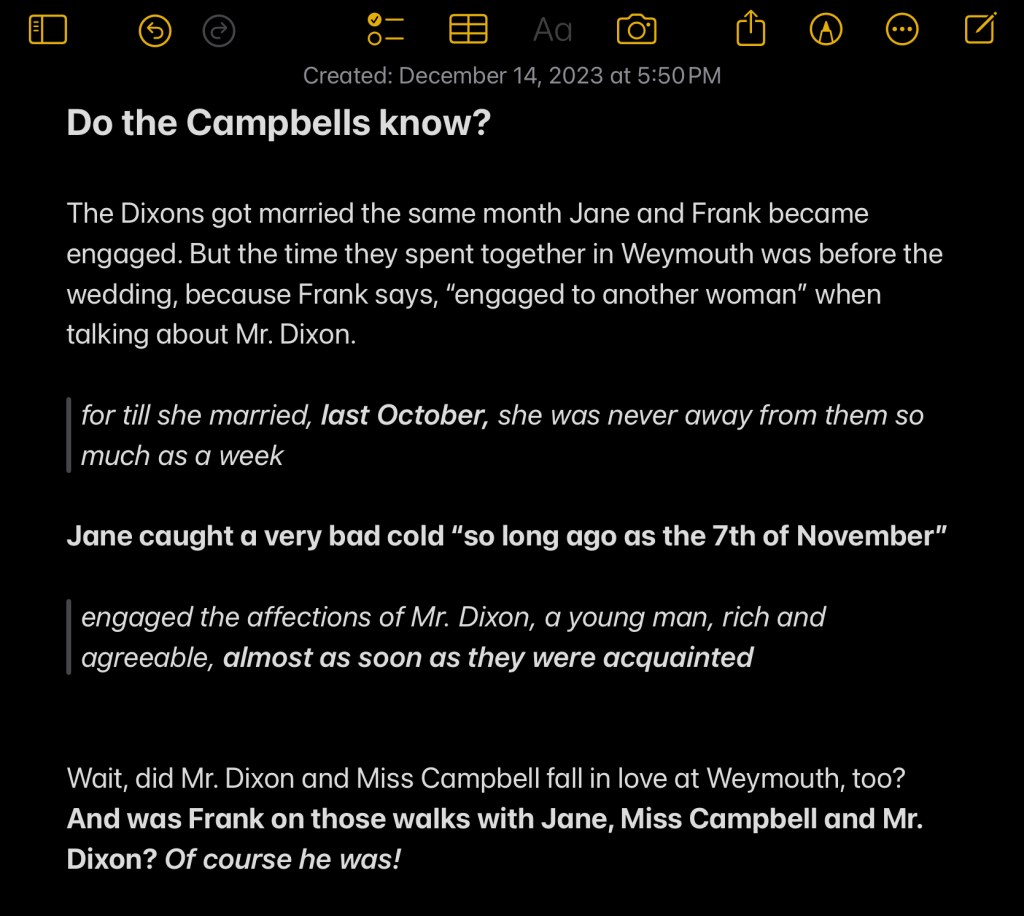
Do the Campbells know?
I hadn’t really listened to Miss Bates’ initial narration—her big introduction in Chapter 19—in a while, even while it’s been playing, because I think I have every bit of it memorized. I think I know it. And I do. But also I don’t. I didn’t. The listening thing—absorbing it whole through my ears while I walk or make jewelry—does something that I am convinced normal thinking cannot do, and perhaps that’s especially true of Emma because the information is so scattered and piecemeal. So deliberately broken up into random bits tossed in by characters who we are primed to expect unimportant nonsense from, wedged between gruel and farm maps, separate from all context and any signifiers of importance. So we can know lots of things without really knowing anything real.
And now, considering how often I’ve studied Miss Bates’ every utterance I am more convinced than ever that everything coming so out of order does a lot more to our minds than we can overcome simply with concentration and patience. It keeps us from forming questions. Or at the very least keeps us from knowing what questions are important. I know we don’t spend our lives just thinking of questions, but also, I know we do. We do it naturally, constantly. It’s how we process information. We’re not computers. We learn by story. We even solve math problems by asking questions and making things fit in a story-like way, and answering this one simple question made everything Emma supposes about Mr. Dixon and Jane look so very— well, you’ll see.
But to construct a story, at least with Emma, you have to start with some sort of question to answer. I know now that I literally need a question in my head to act as the key to putting everything together in a way that makes sense. I have known every fact I used to answer this question for at least a month, but without the key of the question the facts were just flotsam. And like every question I’ve asked so far, the answer revealed itself easily, simply, and coherently packaged in story form. Suddenly there’s images of scenes in front of me and I’m not piecing together facts, but seeing the facts line up and turn into an obvious story.
This particular question did not originate in my brain. It was brushed up against on Reading Jane Austen—(thanks, Michael!)—and was perhaps more of a musing than a real question. Or maybe like me, they all supposed it was tangential even if it was solvable. I will admit that it seemed at most like an irrelevant curiosity until today, listening to that first section of background in Chapter 20 and realizing that there’s a lot of dancing going on about the Campbells trying to respect any firm resolution that Jane commits to and a lot of other meaningless statements that leave the vague idea that Jane departing for her life of “penance and mortification for ever” is something the Campbells are in agreement with Jane about.
Basically, it was starting to sound a lot like the Austen fog machine I’ve become so familiar with, which piqued my interest and made the question resurface. The section, presented as dry facts, is actually quite twisty and everything becomes very slippery once you try to pin any one thing down. And as I turned to corner to start up the big hill towards home I found myself suddenly very curious about what the Campbells knew.
As long as they lived, no exertions would be necessary, their home might be hers for ever; and for their own comfort they would have retained her wholly…
I came in, sat down with my glasses fogging up and my earbuds still in and typed “Do the Campbells know?” into my notes app.
Do the Campbells know?
In a sequence that is quickly becoming familiar, I found myself answering the question to my satisfaction in almost no time, but even better, landing a corner piece in the puzzle of Jane and Frank’s courtship. It’s possible that someone else out there has put this together, too. They certainly could have just as easily as I did, but I don’t know because I just immediately started trying to answer it, and then it jumped in front of me and started answering itself.
☘︎
What did the Campbells know?
There were two couples falling in love. Two couples dancing night after night. Two couples sailing. Two couples—four people, not three—taking those long walks where Mr. Dixon paid his addresses to Miss Campbell and told stories of Ireland. And Colonel and Mrs. Campbell were right there, seeing it happen.
Let’s start with evidence of our earliest date of Frank in Weymouth, slipped into Mr. Woodhouse’s memories of Frank’s “highly prized letter” to Mrs. Weston. (Doubly hidden, as the letter itself is received and focused on in Chapter 2, but the date is given as one of Mr. Woodhouse’s throwaway lines nine chapters later, in Chapter 11, lost in Emma and Mr. Knightley’s expert conversational lifts and volleys, and further buried under Mr. Woodhouse repining about his bad memory to Isabella. That Miss Austen, she is such a trickster.)
“Three-and-twenty!—is he indeed?—Well, I could not have thought it—and he was but two years old when he lost his poor mother! Well, time does fly indeed!—and my memory is very bad. However, it was an exceeding good, pretty letter, and gave Mr. and Mrs. Weston a great deal of pleasure. I remember it was written from Weymouth, and dated Sept. 28th—and began, ‘My dear Madam,’ but I forget how it went on; and it was signed ‘F. C. Weston Churchill.’—I remember that perfectly.”
September 28th.
This isn’t a particularly important date on its own, but it does give me confidence to know Frank was in Weymouth from the beginning of October, and didn’t saunter in mid-month.
And we know that the Campbells, Frank, and Mr. Dixon were “very much in the same set” at Weymouth.
“….I met her frequently at Weymouth. I had known the Campbells a little in town; and at Weymouth we were very much in the same set. Colonel Campbell is a very agreeable man, and Mrs. Campbell a friendly, warm-hearted woman. I like them all.”
And Frank being there to witness Mr. Dixon saving Jane from being “dashed from the vessel” gives context and depth to that idea. As does Frank telling Emma that Mr. Dixon always preferred to hear Jane play when he was engaged to Miss Campbell.
But that last bit of information is especially important, because Frank always talks of the two being engaged when they were together. Engaged and “on the point of marriage,” he says, but not yet married.
But we also know that Miss Campbell and Mr. Dixon were married in October.
“…for till she married, last October, she was never away from them so much as a week…”
But what we know, most of all, is that Frank and Jane were falling in love in Weymouth. And once we look at Mr. Dixon and Miss Campbell we see they must have been falling in love, too. And suddenly those walks with Mr. Dixon talking about Ireland that Miss Austen has primed us to see as Mr. Dixon courting Miss Campbell—with Jane Fairfax tagging along as a sort of chaperone— become Mr. Dixon, Miss Campbell, Mr. Churchill and Miss Fairfax together taking romantic walks and thinking about more than one future together.
“…he should like to speak of his own place while he was paying his addresses—and as Jane used to be very often walking out with them—for Colonel and Mrs. Campbell were very particular about their daughter’s not walking out often with only Mr. Dixon, for which I do not at all blame them…”
Why would Frank stay away from those walks? Or maybe a better question, what sized weapon would be required to keep Frank away from those walks?
So, Miss Campbell and Mr. Dixon were a whirlwind romance, she “engaged his affections almost as soon as they were acquainted,” they married in October, and they were all together in Weymouth. But also, Miss Campbell and Mr. Dixon were not yet married when they hung out in Weymouth.
I remember one proof of her being thought to play well:—a man, a very musical man, and in love with another woman—engaged to her—on the point of marriage—would yet never ask that other woman to sit down to the instrument, if the lady in question could sit down instead—
So now we need a starting point for Mr. Dixon.
☘︎
A whirlwind romance
We don’t know for sure that Mr. Dixon met Miss Campbell in Weymouth, but it immediately becomes the most likely story.
…engaged the affections of Mr. Dixon, a young man, rich and agreeable, almost as soon as they were acquainted
What seems most likely from the evidence we have is:
All three of the Campbells plus Jane went away to Weymouth together. They may have preceded Frank or arrived soon thereafter, but I am going to grant them all most of October in my mind. It seems likely enough and nothing falls apart if it was less time. It’s just a neat and easy starting point.
- In Weymouth the Campbells and Jane met Mr. Dixon for the first time and became more acquainted with Frank.
- I can’t prove that they met the Irish guy from Ireland in Weymouth on holiday, but it seems by far the most likely scenario to begin with and all the facts we do have buttress it. It fits in literally every particular.
- It was a very quick romance — “…almost as soon as they were acquainted.”
- But whether Mr. Dixon’s introduction to the Campbells came in Weymouth or before then, they all quickly became intimate and started doing almost everything together. No matter what variables we mix in, the timing is inescapable that Mr. Dixon was falling for Miss Campbell in Weymouth, when Frank was falling for Jane, so the two couples were, of course, together as much as possible. (Kind of gives a new dimension to “very much in the same set.”)
- Things where affection would have become apparent:
- Dancing. Twice-weekly balls.
- Frank and Jane started singing together and were an immediate hit. I think watching that pair begin singing together in real time would be an unmissable sign.
- Begged for encores: they’re good.
Another song, however, was soon begged for. “One more;—they would not fatigue Miss Fairfax on any account, and would only ask for one more.” And Frank Churchill was heard to say, “I think you could manage this without effort; the first part is so very trifling. The strength of the song falls on the second.”
Chapter 26
- Every other scattered fact I can think of perfectly—perfectly—lines up with the picture that they all met and started hanging out in Weymouth where the Campbells and Mr. Dixon went for vacation. And soon thereafter but still in October both the Dixon marriage and Frank and Jane’s engagement happened.
- One is out in the open. The other engagement is kept secret, but the fact of Frank and Jane falling in love would not have been secret at all. The furthest thing from it, in fact. Secret in Highbury, but not in Weymouth.
And at this point, even before we get to the Highbury-specific part of the question, “Did the Campbells know?” is starting to seem like a ridiculous query. Something the remnants of the teenage girl in me wants to answer with “duhhhhh.” Of course they knew that Frank and Jane were crazy about each other. They were seeing—with their own eyes—both their daughter and Mr. Dixon and Frank and Jane on the dance floor together, seeing both couples obviously and unabashedly attached, and liking and approving of what they’re seeing. Almopst surely approving of both Mr. Dixon and Frank. Frank knows how to make people like him, he has money, and is obviously crazy about Jane. Frank Churchill, charming and exuberant—honestly I cannot even imagine how over-the-top his open courting of shy Jane would be—trying to get her to laugh and blush, happy and totally head-over-heels in love and lust, the son of Mr. Can’t-Keep-a-Secret-Weston in love must have been something to behold. I have zero doubt that the Campbells knew that Frank and Jane were in love. That part of the question, I believe, must be solved to everyone’s satisfaction.
Did the Campbells know that Frank and Jane had Highbury in common?
Duh? Yes. At some point, probably early but it doesn’t much matter when, Frank and Jane figured it out. Probably in Weymouth, but wherever and whenever it was, it’s crazy to think they (or Jane) wouldn’t tell the Campbells, who know Frank about as well as they know their own son-in-law, at least at first. There’s just no reason not to tell the Campbells about this coincidental link. It’s the kind of thing that you tell people. We all like coincidences.
And if none of that is convincing enough, there’s the obvious thing that’s always been there.
Ireland. (oh, duhhhh)
Frank wanted to go to Ireland with Jane and the Campbells but Mrs. Churchill wouldn’t let him. That’s a fact that we know. What does that entail?
Well, first, he must have been invited. So the Campbells know that Frank can’t go to Ireland, and this causes a problem.
…Jane caught a bad cold “so long ago as the 7th of November”
Miss Bates; Chapter 19
Jane gets “ill” on November 7th. For her, we know that ill means unable to eat, worried, eating herself up from the inside out. But that’s a strangely specific date. Could be that’s when they left Weymouth—I think that’s the most likely option—but there’s an outside chance that it could have been when Jane found out that Frank couldn’t go to Ireland. (I think the timing makes this less likely.) But seeing that Jane has become physically ill due to being separated from Frank would worry the Campbells.
And when Frank can’t go to Ireland Frank and Jane would naturally think of Highbury. Frank’s father wants him to go, he needs to go to pay his respects to his new stepmother, and of course Mrs. and Miss Bates would be thrilled to get a visit from Jane. Both of them are desperate to see each other and the obvious move is to meet in Highbury. This means that Jane won’t be able to go to Ireland, but the Campbells, seeing the toll being away from Frank is taking on their Jane probably have some Regency-era thought akin to, “Ireland would kill her, she can’t be that far away from Frank,” and so they encourage her to go get some Highbury “air.” Everyone knew what was happening and the only thing that was a secret was the engagement.
Of course the Campbells knew, and were probably for it if it could work, but after Jane spent month after month in Highbury with so little to show for it would also make them worry and beg her to come to them.
That’s going too far. Too many leaps. The details are unknowable, but I think the only reasonable conclusion is that the Campbells had to know. They had to know about the relationship itself, had to know that Frank couldn’t go to Ireland, had to know that Frank was from Highbury, and would have put together enough to grasp what was intended. They’d have to be dense and blind not to figure it out.
“…But however, she is so far from well, that her kind friends the Campbells think she had better come home, and try an air that always agrees with her; and they have no doubt that three or four months at Highbury will entirely cure her—…”
☘︎
I think two couples met. Two couples fell in love. And two couples got engaged. But that for one of those couples it was more complicated than for the other.
Once you see it you wonder how you missed it for so long. It was always right there.

 Exact Words
2 Comments Add yours