
What I’ve uncovered in Jane Austen’s “Emma”
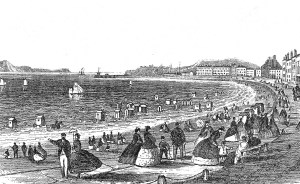
THE CAMPBELLS, WEYMOUTH, AND THOSE WALKS WITH MR. DIXON AND MISS CAMPBELL.
This was one of the most obvious ones. At least once I paused long enough to look.
“…he should like to speak of his own place while he was paying his addresses—and as Jane used to be very often walking out with them—for Colonel and Mrs. Campbell were very particular about their daughter’s not walking out often with only Mr. Dixon, for which I do not at all blame them…”“Emma,” ❦ Chapter 19
There had to be four, not three, on those walks.
Jane wasn’t a third wheel chaperone after all. Frank was there with her.
In my mind I have deconstructed and tried to pick apart all the arguments I made when I was overwhelmed by the insight, but even if Mr. Dixon and Miss Campbell met prior to Weymouth, they still were engaged when they were there, and if Jane went on walks with them I don’t see Frank staying away. That much seems inarguable. And because it was a fast romance and the likelihood of the Irish guy who lived in Ireland meeting them at the place people go for holiday seems high, that’s settled into my own personal background sketch. But even without entertaining the final supposition of them first meeting at Weymouth, I think four people on those walks stays inescapable. I also still think the Campbells had to know. That Jane Austen wrote it as them knowing.
I do think the best part of the thought experiment was finding Frank on those walks with Jane, Mr. Dixon, and Miss Campbell. The moment that became clear was a little magical. It almost felt like Jane Austen reaching out and telling me a secret. A bit like hearing a long-hidden secret and a bit like finding hidden treasure. It’s close to overawing to think that Frank had been there all along. Jane Austen planted him there for us to find. Well, that’s an Emma-like conclusion, perhaps mixing up motivations and effects, but the story was there all along. Just waiting. You really start to understand how much of a basic rough sketch Austen had in her mind before she started scattering disconnected details throughout the pages. Not anything ridiculous like a Tolkien backstory, but a foundation. Something firm enough so that whatever details she tucked around made sense and didn’t contradict each other.
It must have been a lot of fun to write. It certainly feels more purposeful the more I get to know it. I’m usually pretty cautious when it comes to mind-reading dead authors—I don’t like to try to read too much into anything—but this is like nothing else I’ve ever encountered.

Miss Bates is a circus. Miss Bates is a blind.
The Miss Bates Photobomb Rule:
Except for a few small peeks, Jane Fairfax must be hidden in plain sight. What a wonderful problem for Jane Austen to solve! Hallelujah. Because in creating this problem for herself, Jane Austen solved it with the most delightful plot device in the history of story: a little moving, talking circus called Miss Bates to follow her beloved Jane around. And Austen throws that circus tent up not only when Jane is on stage, but when other people are talking about or even thinking about Jane. Every time you try to see Jane, Miss Bates starts juggling.
“Miss Bates is a circus. Miss Bates is a blind.”
Between Chapter 1 and the last two sentences of Chapter 31 there are a total of 4 exceptions to the Miss Bates Rule.
Oh! the coldness of a Jane Fairfax!—Harriet is worth a hundred such—And for a wife—a sensible man’s wife—it is invaluable. I mention no names; but happy the man who changes Emma for Harriet!”
Chapter 31
Each of the four times (before Chapter 32) that Jane gets attention without Miss Bates busting in:
(I do this the opposite way in my most sprawling and sloppy post—The Miss Bates Traveling, Talking Circus: Chapter by Chapter —finding every time Jane is thought of, spoken of, or appears, to see where Miss Bates is.)
Oh, and when I say “the Miss Bates rule” here I only mean people speaking of Jane or thinking of Jane. The rule that if Miss Bates and Jane Fairfax are in the same physical space, Jane cannot be without some sort of intervention, is sacrosanct from beginning to end. Unless Miss Bates is effectively “silenced” there is no Jane. No real Jane.
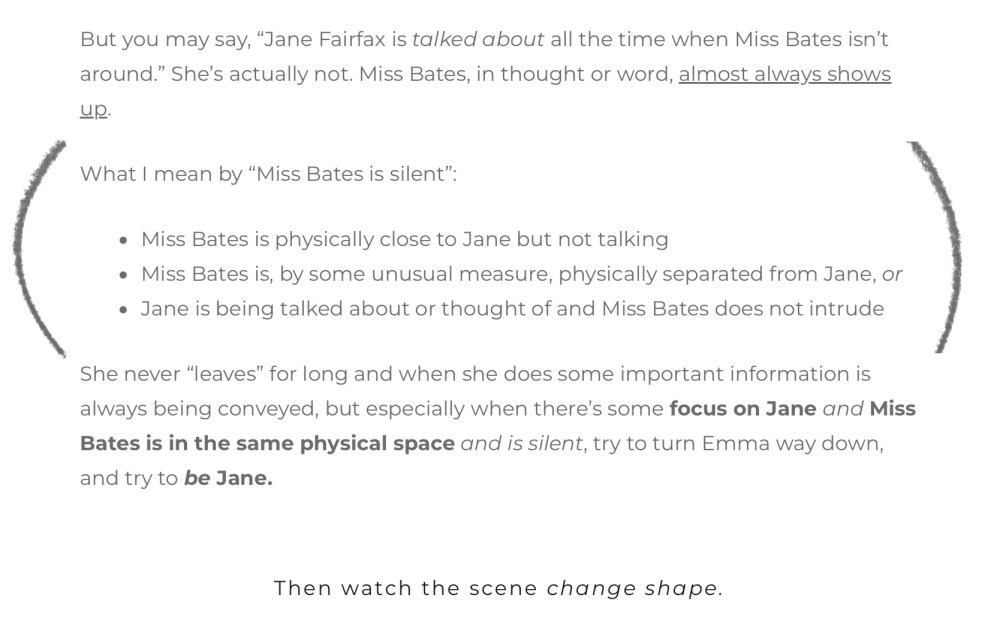
The single exception in VOLUME I:
In VOLUME I Jane is brought up once where she is—in a very obviously purposeful way— separated from Miss Bates. That’s in Chapter 12 where the Knightleys are visiting and Emma and Mr. Knightley keep steering the conversations away from dangerous subjects. We get a brief moment where Isabella talks about Jane. There’s some talk about the Campbells not being able to part with her, but I kind of think the main purpose is the first contrast with Harriet. (Which I think Mrs. Elton’s repeated “resources” is about, too, but I am still not entirely satisfied with that answer.) It is notable that the mention of Miss Bates and Mrs. Bates, brought up by Emma as a distraction, is separated by ten or so paragraphs from this talk of Jane, brought up by Isabella when Emma isn’t paying attention. The other thing about noticing this device is seeing how deliberate these moments are. Austen created a distraction, and from the way she walls Miss Bates off in these few exceptions she seems to have trusted from the beginning that it would work.
Isabella says Jane “would be such a delightful companion for Emma.”
But Mr. Woodhouse isn’t sorrowful that Emma doesn’t have Jane, because Harriet’s just as good. Maybe better.
“Our little friend Harriet Smith…”
It’s interesting that Mr. Woodhouse says “our friend.” I know the term friend was used more inclusively — it was a broader category that could encompass talking about family, older acquaintances, etc. — but here I think it’s more literally true. Harriet is genuinely a great companion for Mr. Woodhouse.
“Our little friend Harriet Smith, however, is just such another pretty kind of young person.”
“Emma,” ❦ Chapter 12
Just such another pretty kind of young person. Lol. Interchangeable with Jane Fairfax. Better, in fact! Harriet, with her riddles and charades is a great friend and companion for Mr. Woodhouse.
“Emma could not have a better companion than Harriet,” says Mr. Woodhouse.
Isabella is happy to hear it, but is all Team Jane. Very politely not moving an inch on Jane Fairfax.
“I am most happy to hear it—but only Jane Fairfax one knows to be so very accomplished and superior!—and exactly Emma’s age.”
“Emma,” ❦ Chapter 12
And then they’re onto smooth gruel and going to the wrong sea.
And three proper exceptions in VOLUME II before Mrs. Elton shows up.
The first two exceptions in Chapters 24 and 26:
In VOLUME II (up until the last two sentences of Chapter 31 and Mrs. Elton’s intro in Chapter 32) there are two brief interludes where Jane is talked or thought about—(in each exception actually being talked about)—without Miss Bates jumping in front of her. They’re both when Emma is confiding her disreputable Jane suspicions to Frank: walking in Highbury in Chapter 24 and at the Coles’ dinner party in Chapter 26. We still don’t get to see Jane in those moments, of course, it’s really more Emma’s fantasies taking over while Miss Bates changes costumes or something. And of course, we know that Emma is wrong, so it makes us curious while keeping Jane a total blank.
Plus the big Jane-Fairfax-Gets-a-Personality preview in Chapter 30
It was not in compliment to Jane Fairfax however that he was so indifferent, or so indignant; he was not guided by her feelings in reprobating the ball, for she enjoyed the thought of it to an extraordinary degree. It made her animated—open hearted—she voluntarily said;—
“Oh! Miss Woodhouse, I hope nothing may happen to prevent the ball. What a disappointment it would be! I do look forward to it, I own, with very great pleasure.”
“Emma,” ❦ Chapter 30
And then, of course, Jane’s “composure was odious” when Frank had to leave. There, she is sort of hidden, but we know she is crushed.
It was some days before she saw Jane Fairfax, to judge of her honest regret in this woeful change; but when they did meet, her composure was odious. She had been particularly unwell, however, suffering from headache to a degree, which made her aunt declare, that had the ball taken place, she did not think Jane could have attended it; and it was charity to impute some of her unbecoming indifference to the languor of ill-health.
“Emma,” ❦ Chapter 30
Poor Jane, just trying to hold it all together.
And then in Chapter 32 suddenly everyone is talking about “Jane Fairfax.” And when we finally get to see Jane with no interference—a full close up—at Emma’s dinner party in Chapter 34, we see a lovely, sweet, quiet young woman.
Who is about to go through some shit.
Mrs. Elton, as elegant as lace and pearls could make her, he looked at in silence—wanting only to observe enough for Isabella’s information—but Miss Fairfax was an old acquaintance and a quiet girl, and he could talk to her. He had met her before breakfast as he was returning from a walk with his little boys, when it had been just beginning to rain.
Chapter 34
Forget Fanny Price, Austen practically tortures poor Jane. Maybe Emma speaks a little for all of us when she says she wouldn’t be able to bear it but for knowing Jane would be happy. (And that things will work out for Miss and Mrs. Bates, too.)
“If I did not know her to be happy now,” said Emma, seriously, “which, in spite of every little drawback from her scrupulous conscience, she must be, I could not bear these thanks . . . It is fit that the fortune should be on his side, for I think the merit will be all on hers.”
Chapter 48
And then the AMAZING piano scene, which is not a technical exception, but for a few moments Jane is all there if you can escape Emma.
“The piano scene” (Chapter 28) where Jane plays her new piano, you can see her if you know where to look. But Miss Bates even breaks through here, including in Emma’s thick delusions, and of course it all comes to a halt for Miss Bates to yell out the window at Mr. Knightley.
“Mr. Knightley I declare!—I must speak to him if possible, just to thank him. I will not open the window here; it would give you all cold; but I can go into my mother’s room you know.”
“Emma,” ❦ Chapter 28
A few of my favorite Miss Bates’ photobombs:
❧ Obviously, the letter from Jane saying she’s coming to Highbury! A letter in a Jane Austen novel that we don’t get to hear?
“…Well, now I have just given you a hint of what Jane writes about, we will turn to her letter, and I am sure she tells her own story a great deal better than I can tell it for her.”
❧ And in Chapter 23 when Frank shows up in Emma’s livingroom with Mr. Weston and first mentions Jane, Miss Bates hops in front of the camera in the funniest way.
“… I shall have no difficulty, I suppose, in finding the house; though Fairfax, I believe, is not the proper name—I should rather say Barnes, or Bates. Do you know any family of that name?”
Chapter 23
“To be sure we do,” cried his father; “Mrs. Bates—we passed her house—I saw Miss Bates at the window. True, true, you are acquainted with Miss Fairfax…”
And right after that, in response to Frank’s understated agreement to Jane Fairfax being elegant—again—the circus comes to town.
…yet there must be a very distinct sort of elegance for the fashionable world, if Jane Fairfax could be thought only ordinarily gifted with it.
An Austen LOL. (Chapter 23)
“If you were never particularly struck by her manners before,” said she, “I think you will to-day. You will see her to advantage; see her and hear her—no, I am afraid you will not hear her at all, for she has an aunt who never holds her tongue.”
❧ And maybe one of the objectively funniest—Emma’s “What about Miss Bates??!” at the Coles’ dinner party.
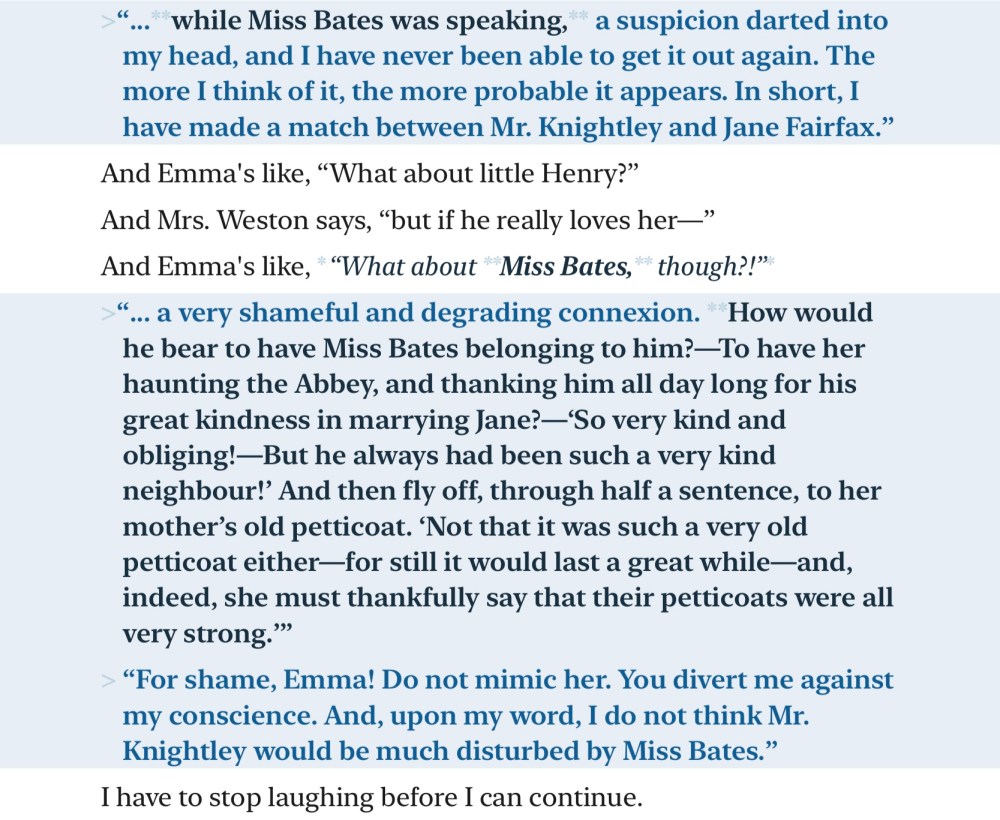
❧ I probably should give one example of how Emma thinks about “Jane.”
Before she had committed herself by any public profession of eternal friendship for Jane Fairfax, or done more towards a recantation of past prejudices and errors, than saying to Mr. Knightley, “She certainly is handsome; she is better than handsome!” Jane had spent an evening at Hartfield with her grandmother and aunt, and every thing was relapsing much into its usual state. Former provocations reappeared.
Chapter 21
Did they? What provocations were those?
Former provocations reappeared. The aunt was as tiresome as ever; more tiresome, because anxiety for her health was now added to admiration of her powers; and they had to listen to the description of exactly how little bread and butter she ate for breakfast, and how small a slice of mutton for dinner, as well as to see exhibitions of new caps and new workbags for her mother and herself; and Jane’s offences rose again.
Chapter 21 • “and Jane’s offences rose again.”
How “Miss Bates”—the device—commonly works.
The most common (and maybe least interesting) way Miss Bates works is just as a default stand in for “Jane” when people talk or think about her. Frank regularly substitutes “Miss Bates” for Jane, and Emma simply “thinks” of Miss Bates instead of Jane whenever possible.
Chapter 30, when Frank almost confesses, is a good example of how Emma and Frank speak to each other around the subject of Jane. Emma actually means Miss Bates, rarely even seeming to consider Jane’s existence, but Frank is thinking only of Jane and believes Emma is, too.
“Not five minutes to spare even for your friends Miss Fairfax and Miss Bates? How unlucky! Miss Bates’s powerful, argumentative mind might have strengthened yours.”
“Yes—I have called there; passing the door, I thought it better. It was a right thing to do. I went in for three minutes, and was detained by Miss Bates’s being absent. She was out; and I felt it impossible not to wait till she came in. She is a woman that one may, that one must laugh at; but that one would not wish to slight. It was better to pay my visit, then”—
He hesitated, got up, walked to a window.
“Emma,” ❦ Chapter 30
“In short,” said he, “perhaps, Miss Woodhouse—I think you can hardly be quite without suspicion”—
And “Miss Bates”—or when possible—“the Bateses” is how Emma “thinks” about Jane Fairfax on the page without actually thinking of Jane Fairfax. Like the way Austen tells us that Jane will be at the Coles’ dinner party tea with the “lesser females” in Chapter 25.
…as the idea of the party to be assembled there, consisting precisely of those whose society was dearest to her, occurred again and again, she did not know that she might not have been tempted to accept. Harriet was to be there in the evening, and the Bateses.
“Emma,” ❦ Chapter 25
And even when by necessity Jane’s name must be articulated, “Miss Bates” is scattered throughout like a talisman.
Like when Mrs. Cole tells the dinner guests about Jane getting a surprise pianoforte in Chapter 26.
The first remote sound to which she felt herself obliged to attend, was the name of Jane Fairfax. Mrs. Cole was telling that she had been calling on Miss Bates, and as soon as she entered the room had been struck by the sight of a pianoforte—a very elegant looking instrument—not a grand, but a large-sized square pianoforte; and the substance of the story, the end of all the dialogue which ensued of surprize, and inquiry, and congratulations on her side, and explanations on Miss Bates’s, was, that this pianoforte had arrived from Broadwood’s the day before, to the great astonishment of both aunt and niece—entirely unexpected; that at first, by Miss Bates’s account, Jane herself was quite at a loss, quite bewildered to think who could possibly have ordered it—but now, they were both perfectly satisfied that it could be from only one quarter;—of course it must be from Colonel Campbell.
“Emma,” ❦ Chapter 26
Then, boom, the “Jane” bombardment cometh.
after Chapter 32 we get a sort of bombardment of attention on “Jane” from all sides.
Her name is repeated again and again by both Mrs. Elton and Emma.
Mrs. Weston and Mr. Knightley, our most trusted voices, give Emma—and the reader—a look at what Jane’s life must be like when Emma wonders why Jane submits to the attentions of Mrs. Elton. (And importantly, the thing modern readers tend to miss is the insult of being called and referred to as “Jane” by Mrs. Elton to everyone. Mr. Knightley theorizes that Mrs. Elton could not possibly call Miss Fairfax “Jane” to her face, but of course, she does.)
Then Jane gets the starring role at Emma’s own dinner party.
And before Jane’s escape from Donwell Abbey we see how it’s all weighing on her, and Emma does, too. “How Jane could bear it at all, was astonishing to Emma. . .”
How Jane could bear it at all, was astonishing to Emma.—She did look vexed, she did speak pointedly—and at last, with a decision of action unusual to her, proposed a removal.—”Should not they walk? Would not Mr. Knightley shew them the gardens—all the gardens?—She wished to see the whole extent.”—The pertinacity of her friend seemed more than she could bear.
“Emma,” ❦ Chapter 42
We are fully empathizing with Jane now.
And when Emma “enter[s] into her feelings” and aids Jane’s escape “with the zeal of a friend,” it’s a relief. We are on Jane’s side, whether we know about the engagement or not.
She spoke with great agitation; and Emma very feelingly replied, “That can be no reason for your being exposed to danger now. I must order the carriage. The heat even would be danger.—You are fatigued already.”
“I am,”—she answered—”I am fatigued; but it is not the sort of fatigue—quick walking will refresh me.—Miss Woodhouse, we all know at times what it is to be wearied in spirits. Mine, I confess, are exhausted. The greatest kindness you can shew me, will be to let me have my own way, and only say that I am gone when it is necessary.”
Emma had not another word to oppose. She saw it all; and entering into her feelings, promoted her quitting the house immediately, and watched her safely off with the zeal of a friend. Her parting look was grateful—and her parting words, “Oh! Miss Woodhouse, the comfort of being sometimes alone!”—seemed to burst from an overcharged heart, and to describe somewhat of the continual endurance to be practised by her, even towards some of those who loved her best.
“Emma,” ❦ Chapter 42
And the turn that will take Jane Fairfax from an obscured figure hiding behind Miss Bates to a sweet, quiet girl enduring pressure from all sides starts in Chapter 32, with the arrival of Mrs. Elton.
Frank Churchill goes. Mrs. Elton steps in.
And once Mrs. Elton is introduced we are paying a lot more attention to a much more sympathetic Jane. From now on the only time we really get Miss Bates stepping in to stand in front of Jane is when it is masking a direct connection to Frank. Namely:
- At the ball
- When Frank saves Harriet he’s been returning some scissors he borrowed from Miss Bates the night before?? At the ball?? And he was in a hurry to get back to Enscombe but also it was such a nice day that he let his horses walk ahead?
See why I say Frank doesn’t think Emma believes him? And doesn’t mean for her to believe him? By this time Frank is 100% convinced that Emma knows. Austen is unambiguous about wanting us to believe this, so it is the correct application of hindsight. Plus, Frank just escorted Jane to the best supper seats at the ball, in front of God and Mrs. Elton. Emma has to know! (Emma should know.) He’s not really hiding it any more.
- Miss Bates tells us in the Mr. Knightley-narrated chapter, Chapter 41, that Jane and Miss Bates had been walking to Randalls when Mrs. Bates heard the carriage talk from Mrs. Perry. (This one isn’t directly about Frank, but I tend to count it.)
- And Miss Bates also gives us the story of Jane taking the job with the Smallridges, where we might or might not notice that Jane took the job right after she discovered that Frank had left for home early and hadn’t said goodbye.
And of course, when Emma and Frank talk. Actually, Frank uses “Miss Bates” as a stand in for Jane to everyone. Emma is not special except in the fact that Frank thinks Emma knows the truth. Another way we know this is because Frank still contrives to be smooth in front of everyone else, but with Emma Frank conjures up the most ludicrous, unbelievable stories anyone could dream up. They’re almost art.
Emma, oh Emma. I wonder how hard it was to invent a character who’s not only self-absorbed enough to ignore the most ridiculous wink-and-nod lies ever told, but also to make most readers ignore those absurdities at least once? That took serious skill on Miss Austen’s part.
About a month ago I wrote a little about how I ended up here, how Emma began revealing her secrets to me. How I think listening to it over and over again while I made jewelry was what turned the trick.
And I don’t think you can do that by reading—look at it as a story again and again and again and again until its shape and contours reveal themselves, like rock formations—because your brain and your body won’t sit still long enough. But listening is different. And I suspect that listening while stretching the creative functions of one’s brain in as tactile a way as I do is especially conducive to the creative autopilot mode of my brain. The less exciting parts of the book fade into the background, and at first I suspect I am primed for the set-pieces, until slowly the other scenes start to sink into place around the ones I most anticipate. That’s what listening to something a ridiculous amount of times does. It sinks into you. It’s like you absorb the book.
How I got here…
And now that nearly another month has passed and I’ve found a few more secrets, I will say that one thing remains true: what increases in weight most with every re-listen is all the minute humiliations Jane is subjected to. The way they pile up. Austen has no mercy on Miss Fairfax. The fact that Miss Bates says Jane “almost quarreled” with her for admitting to Mr. Knightley that they were low on apples is enough information to be certain of what we would suspect anyway, how embarrassing it is for Jane to have so much focus on her at all, but especially in ways attached to acts of charity. Being marched in for tea with “the less worthy females” by the Coles, not to mention being called “Jane” like she’s a servant by both the Coles and Mrs. Elton, must be like suffering a thousand deaths for someone like Jane. I in no way think she has any hubris, but I think that would really hurt her. That it would injure her dignity. And Mrs. Elton is a spiteful woman who she cannot risk making angry. Miss Bates can’t even keep the woman out of their home. She is inescapable.
I did not “discover” how terrible it is that Mrs. Elton calls Jane Fairfax “Jane,” but it is terrible.
Readers in Jane Austen’s time would have recognized it, but it is something we tend to miss. It is not just a too-intimate vulgarity, it’s an insult. You cannot fudge the rank part of it. It is a constant and public humiliation, and that’s what Mr. Knightley’s “she and thou” speech is about. And we cannot fully appreciate all that Jane is enduring without giving this constant and inescapable slight to Jane its full weight.
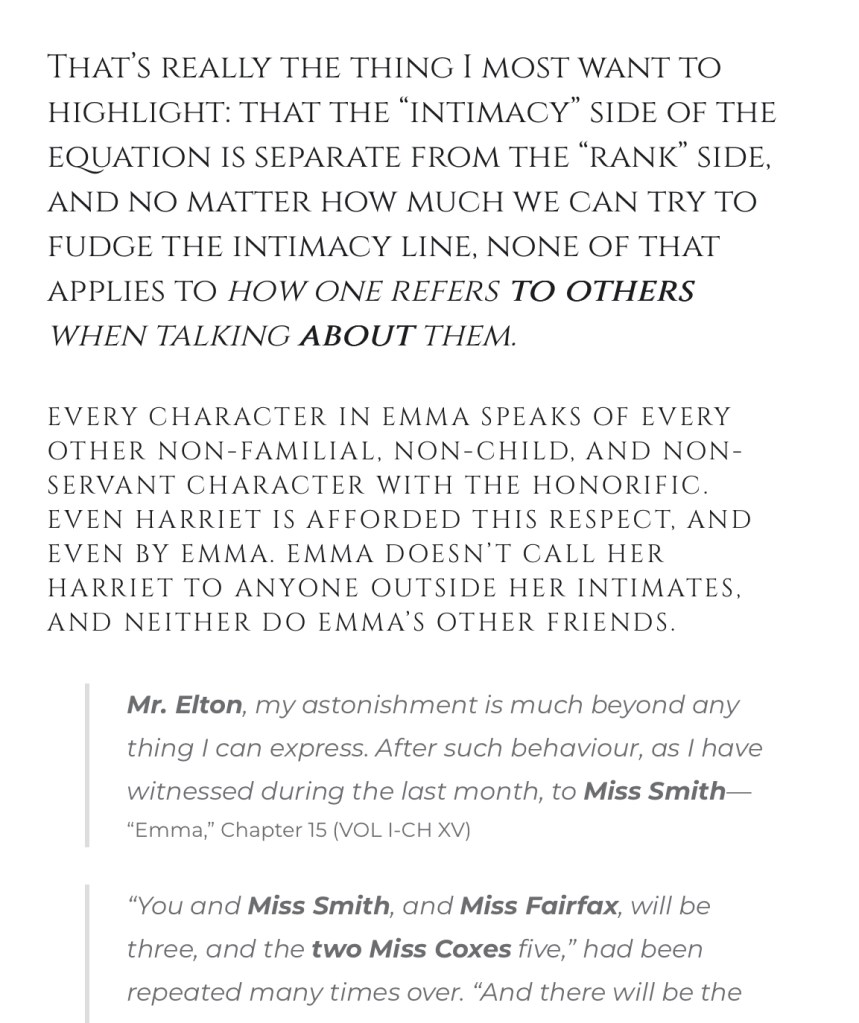
Once you stop to pay attention, you’ll see that no one else who is not a servant is referred to by their first name to others. Not even Harriet.
Each and every “Jane” is a public designation of inferiority. And each and every one would feel like a slap.
Another non-discovery I still want to shout about is the awesomeness of The piano.

The ridiculous re-reads and re-listens have also made me think how much joy as a little family the Bateses and Jane would have gotten out of the piano. All of them, individually and together. I want to give Frank a little love and appreciation for that most romantic of gifts. Because we don’t find out until the end that Frank sent it, and then only get a reaction from—of all people—the unromantic Mr. Knightley, I think everyone misses just how incredible that gift was. How life-changing for Jane. I certainly missed it at first. Whatever else was going to happen to Jane, and despite every complication it would bring, that baby would be Jane’s forever and ever, whenever she wanted it, and knowing that would make everything warmer on cold nights. I am more positive of that than I can say. The Campbells would look after it for her, but it’s hers. She would never have to sit and despair that she might live her whole life and never have her own instrument, and that is exactly the kind of dark thought that any musician would fall prey to at times. My quiet, uncomplaining mother, not half the player Jane is, went a few years of my early life without one and I still remember how much it occasionally got to her. To want to play and not be able to is bad enough, but to want to play and think you may never be able to except at someone else’s pleasure, is much worse. And apparently the pianoforte Frank gave Jane would have cost about £35, which is the equivalent of about £2,000 today. So it’s just objectively a big deal.
The “Piano Scene: Through Jane’s Eyes“
Nothing else shifted my views of everything more than this: the scene Austen had hidden beneath Emma’s delusions in Chapter 28. It’s actually quite romantic.
What made the assembly shine?
“Robin Adair“ ❦ The song bearing her Irish husband’s name was written by Lady Caroline Keppel in the 1750s as a rebuke to her family for what she perceived as their snobbery regarding her handsome and accomplished lover.
Robin Adair.
What made the ball so fine?
Robin was there:
What when the play was o’er,
What made my heart so sore?
Oh! it was parting with
Robin Adair.
While not exactly a discovery, in trying to excavate what Austen buried under the distractions, Frank came out looking much less muddy in Chapter 28. Emma really twists our minds in that scene and it’s hard to separate what’s actually happening from her thick delusions. Even just stopping to make sure I knew where Frank was at each point—literally blocking out the scene—was helpful and harder than I expected. The whole thing is doused in a constant firehose of Emma’s most unrealistic fantasies, and they’re exceptionally hard to overcome, but underneath there’s a few moments that are really quite beautiful. Jane is there. Jane and Frank. In fact, Chapter 28 is one of my favorites now. Even as uncomfortable as it made me at first. And I am confident now that the reason it feels so strange and discordant is because the space between Emma’s delusions that we’re forced to look through and what is going on underneath them is so different. (I generally think of them as fantasies, but for this scene that is simply not enough. She keeps telling Frank to stop doing something he isn’t doing, and yet it takes force of will and the concentration of a Jedi to escape her unreality.)
It’s such a good example of how much Emma can alter our perception. Once you see it there, it cracks open a window into everything else.
And the only place Mr. Dixon exists in that scene is in Emma’s mind.
And because Emma’s delusions are so strong, I want to point out that after the Coles’ dinner party in Chapter 26 neither Frank nor Emma says “Dixon” or refers to the Dixons until the alphabet game. Emma thinks things, but that’s all.
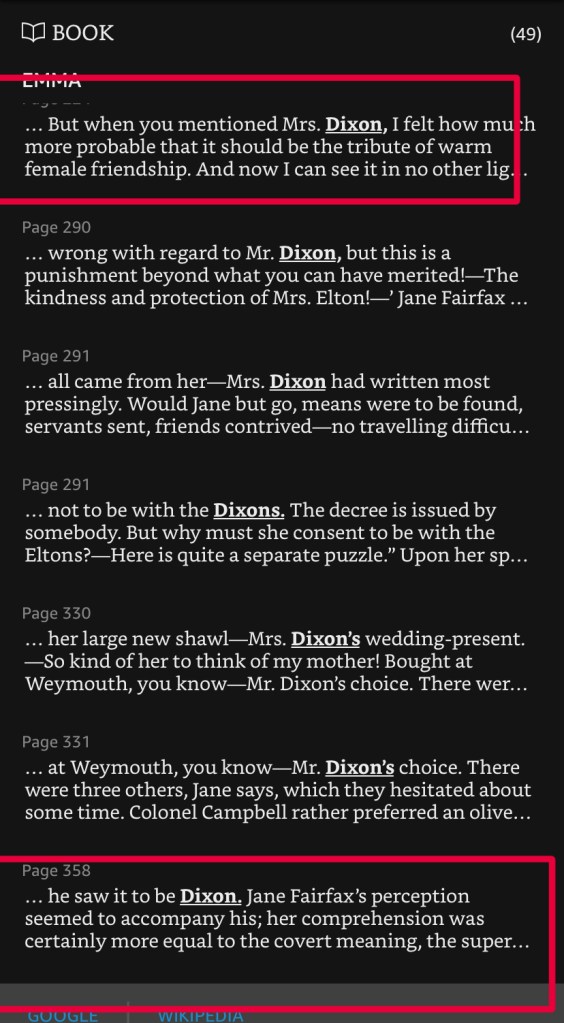
A thing to remember: Jane Austen is clear that Frank thinks Emma knows after Chapter 30, and he is confident she does after Chapter 38. But we tend to forget to take that onboard in subsequent readings. Nonetheless, I did try.
If Frank thinks Emma knows, how does that change every scene after Chapter 30?
How does everything look from Frank’s POV if Frank begins to believe that Emma knew or strongly suspected the engagement before he left the first time? Because once I started thinking of what he and Jane would be writing in letters, just the most basic stuff, his case suddenly became very strong. He and Emma are almost equally delusional in some ways, but what happens when Jane gets an invitation to come to Emma’s dinner party, very soon after Frank departs? After almost confessing because he thought—not unreasonably—that she must suspect. Of course Jane would tell Frank about the invitation in a letter. And if Frank didn’t tell Jane of his suspicions then, he certainly would once Jane writes to say that not only was Emma very nice to her, but she also took Jane’s arm and escorted her into the dining room herself. (That’s a very big deal.)
Both Frank and Jane would have to be wondering what in the world was going on.
And by the way, I feel the pull of the “don’t overthink things” instinct as much as anyone can, but because Jane Austen so deliberately has Frank write that he believed Emma knew since his first departure, and then she goes back to it again by having Frank ask Emma at the Westons in a sort of wonder if she really didn’t know, I have to believe that Austen thought through a scenario of the facts to fit that premise. And so far it feels exactly like a more involved version of the “What did the Campbells know?” question.
Things that appeared to either have no significance or felt a bit extraneous before are jumping out and fitting into the alternate story like a series of keys into locks.
Although the ABC Game is looming ahead, just processing Emma’s dinner party from this point of view is like being sucked into a different universe. Frank, at home again and wondering about everything that’s happening in Highbury, would only see Emma going from, “Intimacy between me and Jane Fairfax is quite out of the question” to a sudden dinner party invitation. Which I think Jane would be confused and surprised about right along with him. And she would surely be curious and probably a bit nervous about what kind of welcome she would receive. But Emma not only treats her well and interacts with her normally, she also takes Jane’s arm and gives Jane the honor of personally escorting her to the table. It’s a dizzying change of attitude. Why? What does it mean? And with Frank (and probably Jane) trying to figure it out, suddenly maybe Emma bringing up Frank’s handwriting right before taking Jane’s arm in a gesture of friendship can seem less like a disharmonious note and more like a hint to Jane that she knows who the letter was from. Everything shifts just enough to make sense when seen through different eyes. (Frank will still be a heel, but perhaps a slightly less obscene one in the ABC Game. At Box Hill I can only fry him, and I refuse to consider any mitigating factors there. That’s the first scene I tried to write from Jane’s point of view.)
❧ The seeds of this post came from an email reply to Harriet, co-host of the Reading Jane Austen podcast.


