–NOTE– For those just arriving to this man-made disaster: On January 3, 2023 I posted my essay “A BEATLE DIDN’T SAY THAT” and on January 15th Sharon Dubosky contacted me. She immediately began plowing through sources and recording her findings on an ever-expanding Tune In Error Spreadsheet. As of May 11, 2024 she had checked a total of 544 citations and recorded 212 major errors.
“I’ve said this before, but it really comes down to the fact that, in my view, the Beatles stood for truth. And that they can best be served by a piece of biography– a piece of work like this that is utterly truthful—in every line, in every sentence, in every paragraph and chapter, every page.”
—“UTTERLY TRUTHFUL” – Mark Lewisohn ❦ Humans in Love podcast, featuring Zachary Stockill. Ep1—Part Two • Mark Lewisohn (May 22. 2018)
“I need to do the book, the history” – “I just decided this has to be done really properly” – “It’s very important that I write this book now, because otherwise it will be wrong forever. And the primary reason for me doing it is to ensure that it’s right… if I don’t write these books it will be wrong forever. It will be misunderstood forever… it’s only really me who’s really out there trying to get it right. …” – Arte da Biografia (April 26, 2024)
Mark Lewisohn: Wrong Forever
Last year Jonathan Eig, a bestselling biographer and winner of the 2018 PEN America Literary Award for “Ali: A Life,” was doing research for his new MLK biography when he made a shocking discovery that is having vast historical reverberations, especially in America. Eig dug out the original transcripts of Alex Haley’s interview with Martin Luther King for the January 1965 issue of Playboy Magazine—the longest published MLK interview on record, released just over a month before Malcolm X’s assassination—and saw that Haley had fabricated parts of Martin Luther King Jr’s words and grossly misused others. This falsified quote has become part of our historical record—something everyone “knew”—and has been taught and written about and repeated over and over again. Because Alex Haley manipulated Martin Luther King Jr’s words, our understanding of these two important Civil Rights figures has been warped for decades. We have misunderstood them and their relationship, seen a degree of enmity that wasn’t there, and debated arguments that were based on a false foundation.
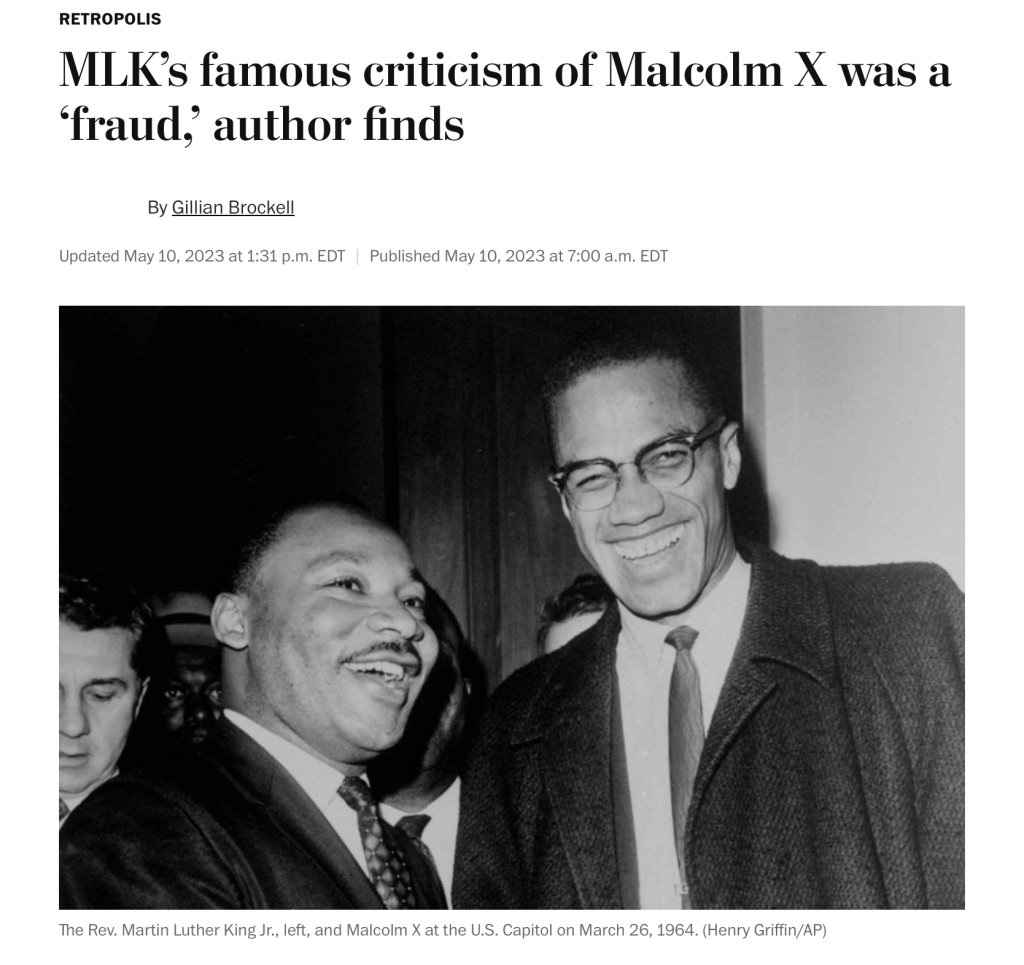
If Beatles scholars had been paying attention when this story broke—and had known then what we know now—they might have looked down at the fault line they were standing on and wondered if the shaking they felt was coming from their stomachs or the ground beneath their feet.
Because everything that Alex Haley did in a single quote, Mark Lewisohn does on page after page. And both seem to fall prey to the same Satan: wanting to end with a bang. Lewisohn almost always inserts his original words into the first or last line of a quote.

Alex Haley’s sins are very familiar. He made up parts of the quote and took one very inflammatory sentence from an answer to an entirely different question—“Fiery, demagogic oratory in the black ghettoes urging Negroes to arm themselves and prepare to engage in violence can achieve nothing but negative results”—and spliced it into MLK’s answer about Malcolm X.
Both of these issues are, unfortunately, consistent Lewisohn practices.
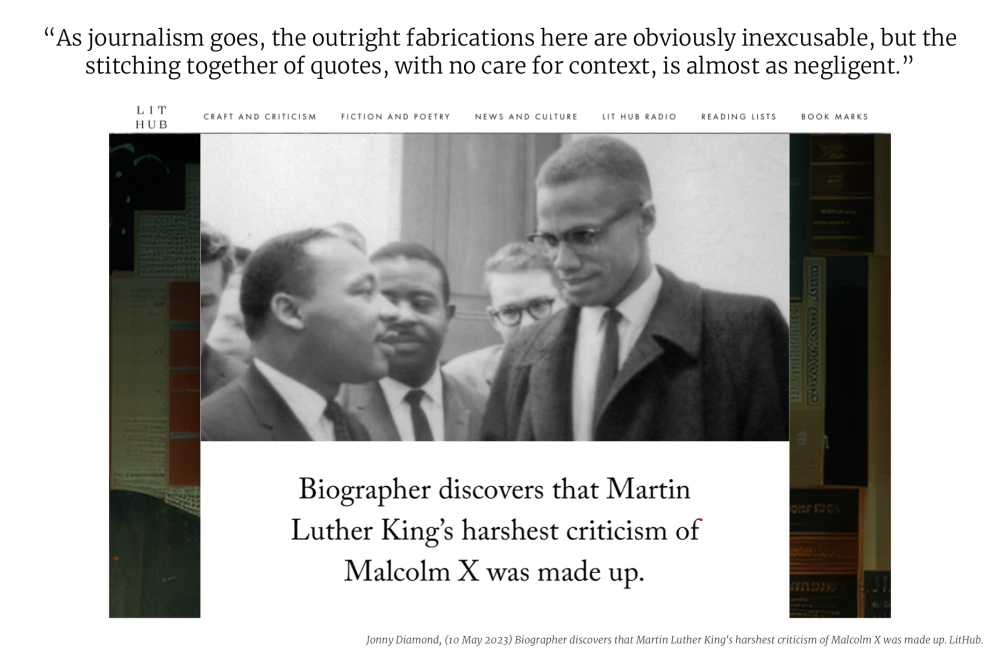

As earth shaking as this revelation has been to American historians, it is, in the end, but one falsified quote. The damage assessment, while wide, is something that can be comprehended. With Lewisohn, it’s hard to even know where to start the repair. Every delineation of Haley’s alterations to the words of his subject are, for Lewisohn, a matter of course. They are things that Sharon Dubosky and I share ten examples of on some days. But more than that, at least with Haley we have a straightforward interview with no narrative exposition. With Lewisohn, the twisted quotes are used to manufacture whole narratives that are false. That is why I have so much trouble writing about any one sin. As soon as I focus in on one fabrication I find, again and again, a house of cards. A clearly fabricated storyline that goes far beyond the twisted quotes.
The twisted quotes are just the peeling paint and paste holding the story up, and once they fall, the new, never-before-uncovered-Beatles’-story collapses.
But the biggest problem Beatles’ scholarship is facing from Lewisohn’s mess comes down to the biggest similarity between Haley and Lewisohn, and the two words that continually strike me with fear: “author interview.” That so much of Tune In is based on Mark Lewisohn’s own, unpublished, author interviews is a devastating blow, because those interviews are unbelievably untrustworthy.
There are two reasons we know that. The first is the simplest: we can see what Lewisohn does with the words from published interviews. He invents whole new lines, reverses things, twists things, adds color, combines random words from multiple quotes, omits vital sections with no representation, and takes things so wildly out of context that I have run out of adjectives to express my shock.
But the second reason is that when we are able to get a little light and insight into what Lewisohn represents as coming from an author interview we immediately see other evidence of fabrication, like obvious plagiarism.
Plagiarizing Thelma
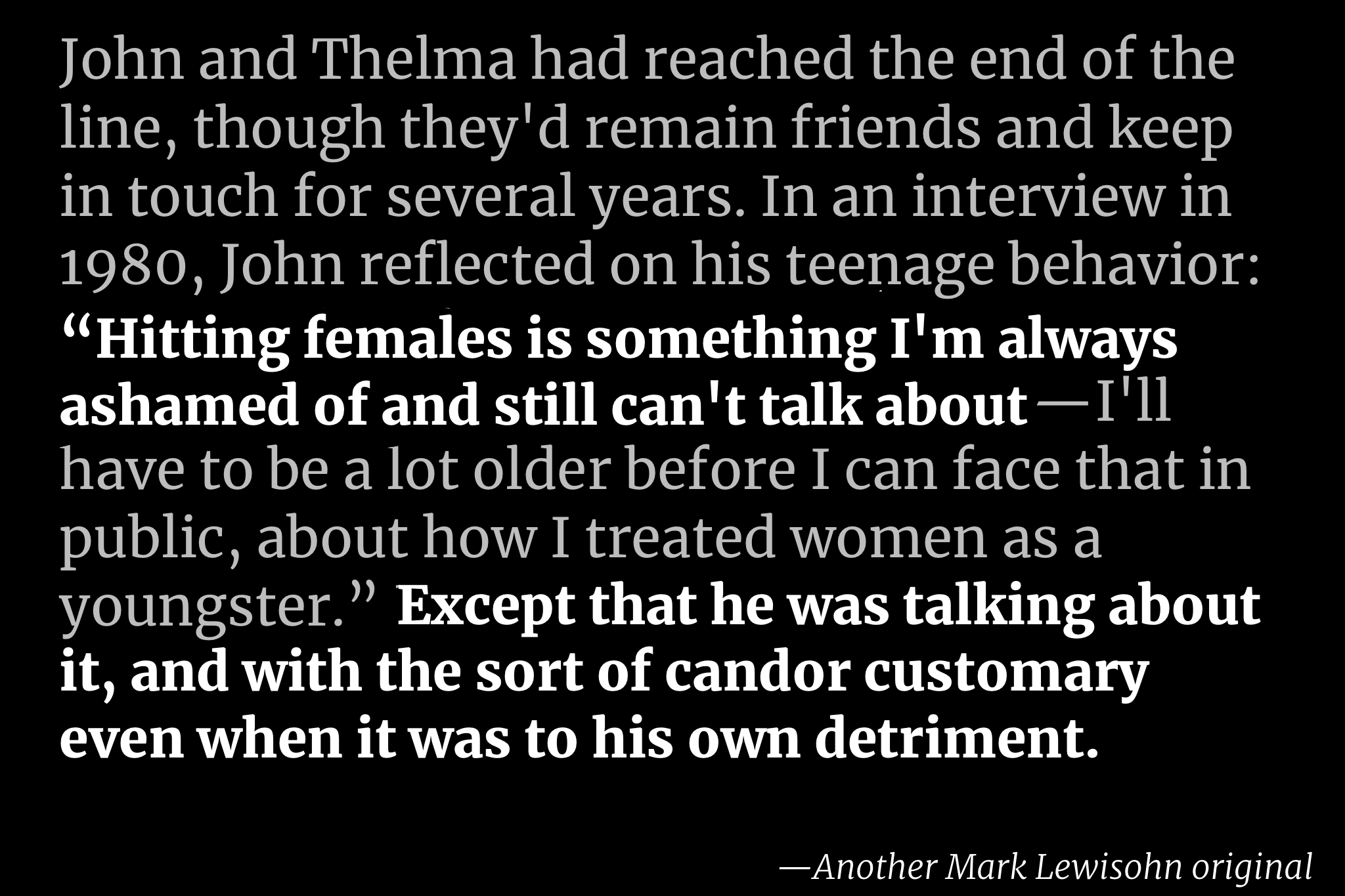
Yes, it appears that Lewisohn made up the first part of that John Lennon quote so that he could then answer it with authorial praise of John’s “candor”—and the other Lennon quotes he uses when addressing John hitting Thelma are also butchered—but that deserves more attention than I can give it in this piece.
For this piece it is the plagiarism that is most relevant, not because it is plagiarism, but because of what the plagiarism is cited as: an author interview.
Mark Lewisohn interview: arte da biografia (April 26, 2024)
“There are Grade A witnesses to this history who’ve never advertised themselves to writers, and whose nature is to not speak until they feel the time is right. They’re throughout this book, and the immediacy of their quotes is breathtaking in places.”
—Mark Lewisohn: Q & A with Mark Lewisohn (on his website)
Thelma, in her own words
Thelma Pickles McGough gives us insight into something Lewisohn usually keeps under careful wraps. With Thelma we get to see an “author interview” by Mark Lewisohn that occurred less than a year after her own story in her own words appeared in the Guardian Observer.
In December 2009 the Guardian published multiple stories told by people who knew John Lennon, and Thelma’s told how she and John went up to the art room during a dance for a “five-mile run,” how there were other people in the room and so she refused to stay, and how—in her words—Lennon “yanked me back and whacked me one.” Lewisohn then contacted her about eight months later, in August 2010, and interviewed her in September. His interview with Thelma was one of the last he conducted for Tune In. And although he really minimizes her story, is embarrassing in his level of excusing John for things John himself never tried to make excuses for, and heinously mauls almost every quote, what matters here is what makes her sections unique: we can see Mark Lewisohn copying off Thelma’s paper and calling it an author interview.
Thelma • Guardian:
John was enormous fun to be with, always witty, even if it was a cruel wit. Any minor frailty in somebody he’d detect with a laser-like homing device. We all thought it was hilarious but it wasn’t funny to the recipients. Apart from the first instance, where he mocked my name, I never experienced it until I ended our relationship.
Thelma Pickles McGough – Guardian
LEWISOHN • Tune In – “AUTHOR INTERVIEW”
- Given as a direct quote from said interview, Lewisohn uses Thelma’s exact words from the Guardian:
He spoke of the pure shock of losing his mother, and he said what a loss it was (though I don’t think he used the word “loss”). At such times, he spoke in a much softer, more explanatory way than usual, and though he never demonstrated extremes of emotion, his pain was clear. The other side of the coin was that he’d detect any minor frailty in somebody with a laser-like homing device. I thought he was hilarious, but it wasn’t funny to the recipients. (31)
Lewisohn, Tune In • (9-31: author interview)
❦
This next paragraph isn’t actually cited to anything, so it’s hard to know what to make of the lifts. They’re supposed quotes, and except for the borrowed phrasing they’re definitely not anything else, either. It’s odd.
THELMA • Guardian Observer:
John was enormous fun to be with, always witty, even if it was a cruel wit.
Thelma Pickles McGough, Guardian Observer
LEWISOHN • Tune In:
Mostly, Thel found John “enormous fun to be with, always witty, and when we were alone together he was really soft, thoughtful and generous-spirited.”
Lewisohn, Tune In
And then we find that even the “really soft, thoughtful and generous-spirited” line has been burgled, except Mr. Lewisohn didn’t like the way Thelma had told her own story, so as he often does, he took her words into his lab and reconstituted them to fit the story he wanted to tell. (A story that minimized Thelma’s true history, and used—or misused—her own stolen words to do it.)
GUARDIAN
“John was enormous fun to be with, always witty, even if it was a cruel wit.”
+
GUARDIAN
“When we were alone together he was really soft, thoughtful and generous-spirited. Clearly his mother’s death had disturbed him.”
=
TUNE IN
Mostly, Thel found John “enormous fun to be with, always witty, and when we were alone together he was really soft, thoughtful and generous-spirited.”

I concentrated on the repeated phrases because they are the most identifiable and inarguable causes of concern, but in all but one of Lewisohn’s sections focused on Thelma and John, his paragraphs are just reconstituted paragraphs from Thelma’s Guardian piece, with some additional, easily identifiable Hunter Davies and Ray Coleman seasoning sprinkled in. And again, I am pointing to Thelma because aside from the glaring problem of the plagiarism in-and-of-itself—which is obviously no small matter—she provides unique prima facie evidence of deception in a Lewisohn author interview citation. Because once we know, for sure, that the words Lewisohn is telling us come from one of his opaque “author interviews” are undeniably falsified, it removes the last hint of doubt. We cannot trust any representation of a person’s words from Mark Lewisohn that cannot be independently verified.
Unfortunately, huge sections of the edifice of Beatles’ knowledge has been built with Lewisohn bricks and mortar, and an enormous cross-section of those Lewisohn bricks are author interviews.
❦
A House-of-Cards Storyline
One thing I have discovered in the last few months is how very difficult it is to tell a tale of a manufactured tale, to show the truth behind a tale made up of truths, half-truths, and lies. I have learned just how hard it is to tell a story of how a story is falsified. So while I have unwittingly become an astute spotter of Lewisohn’s adroit phrasing—things immediately stand out to me now that I would have overlooked five months ago—I have also learned that spotting and identifying a mass of hollow bricks is easier than making the unstable architecture clear to a third person. Untangling knots is always frustrating and difficult, but representing that untangling in a semi-reasonable time and in a comprehensible way is a challenge I have yet to fully master.
However, showing how a trick works by focusing on a single sleight-of-hand can be quite revealing. By pulling back the curtain and showing the springs and mirrors powering one illusion—a single building block of a mostly-manufactured narrative—you can look up and, perhaps, see the tower start to sway.
“The rules for writing history are obvious. Who does not perceive that its chief law is never to dare say anything false, and never dare withhold anything true?”
—Cicero
“Paul didn’t want Brian as the Beatles’ manager…”
Mark Lewisohn is very determined to rewrite large sections of the-Beatles-and-Brian-getting-together storyline, including casting Paul as a saboteur who didn’t want Brian as the Beatles’ manager. I have been working on untangling this section for months, and as soon as I think I’ve found firm footing another board cracks beneath me. The section is unbelievably warped, and this “quote” is—unfortunately—very representative of the “quotes” it is built on. And as bad as the “quotes” are, the representations of other sources are vastly worse.
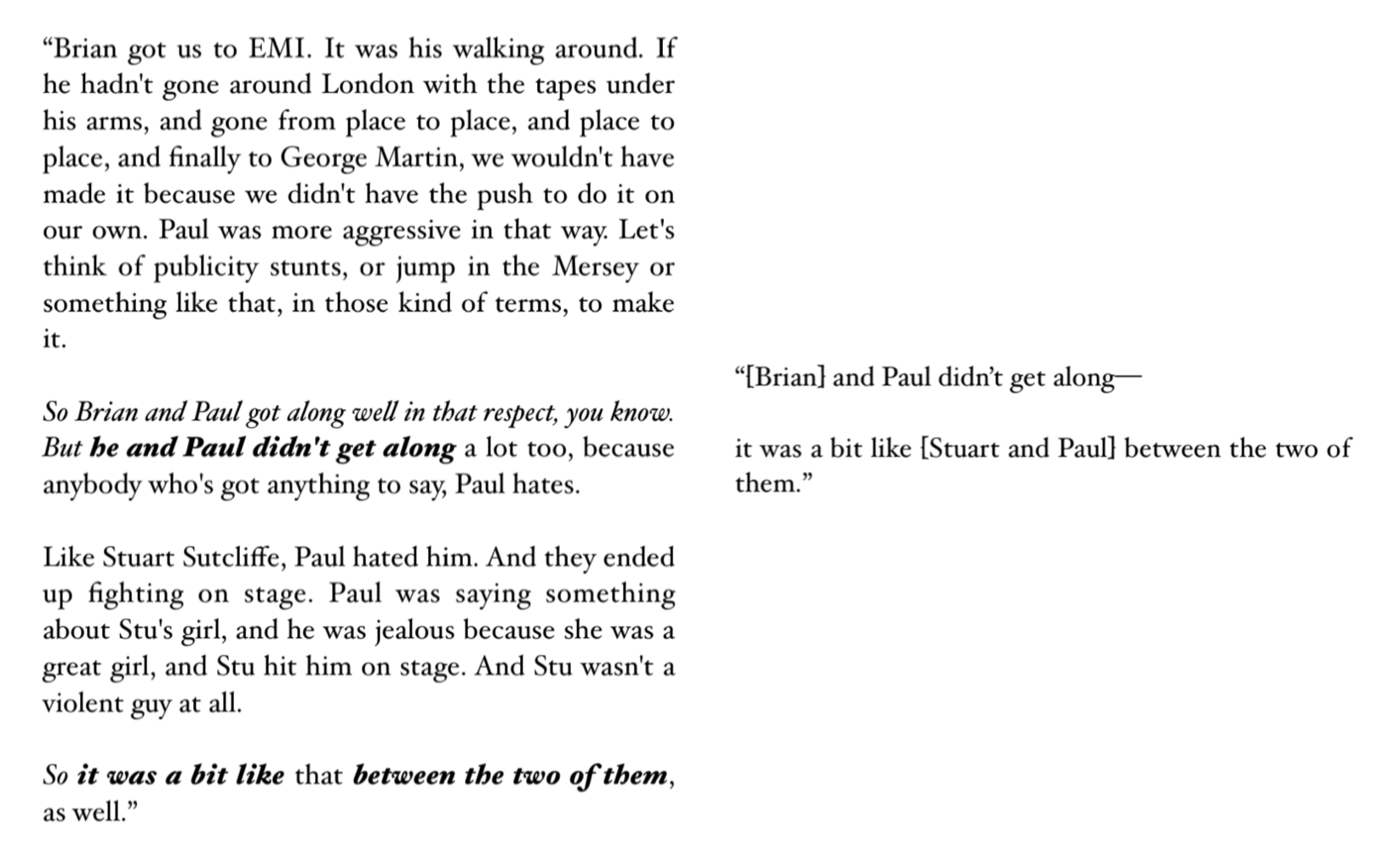
“Emphatic” John
However, John remembered Paul’s attitude to Brian being very different. John was always emphatic that Paul didn’t want Brian as the Beatles’ manager and presented obstacles to destabilize him, to make his job difficult … like turning up late for meetings. “Three of us chose Epstein. Paul used to sulk and God knows what … [Paul] wasn’t that keen [on Brian]—he’s more conservative, the way he approaches things. He even says that: it’s nothing he denies.” [72]
–
(p512) • NOTE: both ellipses are in the original Tune In text. ☙ [Footnote 72: First part from interview by Jann S. Wenner, Rolling Stone, May 14, 1970; second from interview by Lisa Robinson, Hit Parader, December 1975.]
Lewisohn is determined to contradict every major player and Brian Epstein’s own calendar and move the Beatles’ first meeting with Brian to November 29th, but on what Lewisohn calls their second meeting on December 3rd—the one where Paul was late, but clean—Lewisohn begins the Paul-was-trying-to-sabotage-Brian-theme in earnest. After tarring Paul with a casually antisemitic “compliment” apparently made by Jim McCartney about Jews being good with money, Lewisohn launches in, using “John’s” point-of-view throughout as proof that Paul never wanted Epstein as the Beatles’ manager.
We start out with a classic Lewisohn Frankenquote pulled from two interviews conducted more than five years apart. And those five years made a huge difference. In technical terms, it is generally improper to combine words from two different questions within one set of quotation marks, let alone from two separate interviews, but in this case the Wenner section comes from John just one month after Paul’s album release Q & A signaled the breakup, shocking the world and blindsiding John, while Lisa Robinson was talking to John after he fired Klein, after the Lost Weekend, and after the final divorce papers were signed. So although Lewisohn regularly creates new “quotes” made up of words spoken several years apart, the circumstances separating these two interviews—presented as one thought from John Lennon—are particularly egregious, even for Lewisohn.
But that unpardonable historical outrage must simply be context, because it gets so much worse so remarkably fast.
When I’m working with these monsters I divide them into parts to make them more manageable, so let’s start there. This “quote,” while composed of two different interviews, is further cherry-picked from within the Wenner interview. So I’ve labeled the Wenner bits [72.1.1] and [72.1.2] and the Lisa Robinson bit [72.2].
However, John remembered Paul’s attitude to Brian being very different. John was always emphatic that Paul didn’t want Brian as the Beatles’ manager and presented obstacles to destabilize him, to make his job difficult … like turning up late for meetings. “Three of us chose Epstein. [72.1.1] Paul used to sulk and God knows what [72.1.2] … [Paul] wasn’t that keen [on Brian]—he’s more conservative, the way he approaches things. He even says that: it’s nothing he denies.” [72.2]
Lewisohn, Tune In ❦ (22-72)
First of all, it’s a weird “quote” on its face. As soon as you separate it out from Lewisohn’s introductory framing it starts to fall apart. It’s not how anyone talks, let alone how John Lennon talks. We know how John sounds. He rants about things in a strangely charming way, and although one rant might contradict another, they’re all engaging and entertaining, and even when he rambles he expresses himself with a feeling and guilelessness that connects. John is good with words—even when he doesn’t mean to be—and he certainly gives writers plenty to work with. But here Lewisohn tells us that John emphatically “remembered” Paul’s opposition to Brian and all the obstacles Paul put in Brian’s way, but follows it with this weird, weak jumble that doesn’t seem emphatic about anything, and barely even sounds like John. And these are the words Lewisohn is giving us as evidence from John that not only did Paul not want Brian as manager, but that he actually “presented obstacles to destabilize him” and to “make his life difficult”.
And it is worth pausing to fully appreciate the claim that Mark Lewisohn is making here. He is stating, in black and white, that Paul McCartney “didn’t want Brian as the Beatles’ manager”—and that is, quite simply—a big claim to make. Even before we get to Paul “presenting obstacles” or John being emphatic, I wanted to slow down and repeat it, because I have spent months untangling these sections that paint Paul as a saboteur—combing as many sources as I can lay hands to—and have found nothing to support it, nor am I aware of anyone else proffering this strong, blanket claim—and I wanted to be sure that we’re all on the same page.
Let’s take John’s “quote” at face value as a real quote for a moment and try to parse out what it does support:
- Paul didn’t want Brian as manager: “Three of us chose Epstein” could support that—depending on the context—and if you stretch I suppose that “[Paul] wasn’t that keen [on Brian]” kind of does? Not really, and certainly not emphatically, but it might help it a little.
- Paul not denying being “more conservative” seems irrelevant to the thesis statement. (But perhaps with more context I would change my mind.)
- Paul presented obstacles: The only part of that “quote” that could be evidence of Paul presenting obstacles to destabilize Brian is Paul “sulk[ing] and God knows what.” Was Paul’s big play to destabilize Brian sulking ?
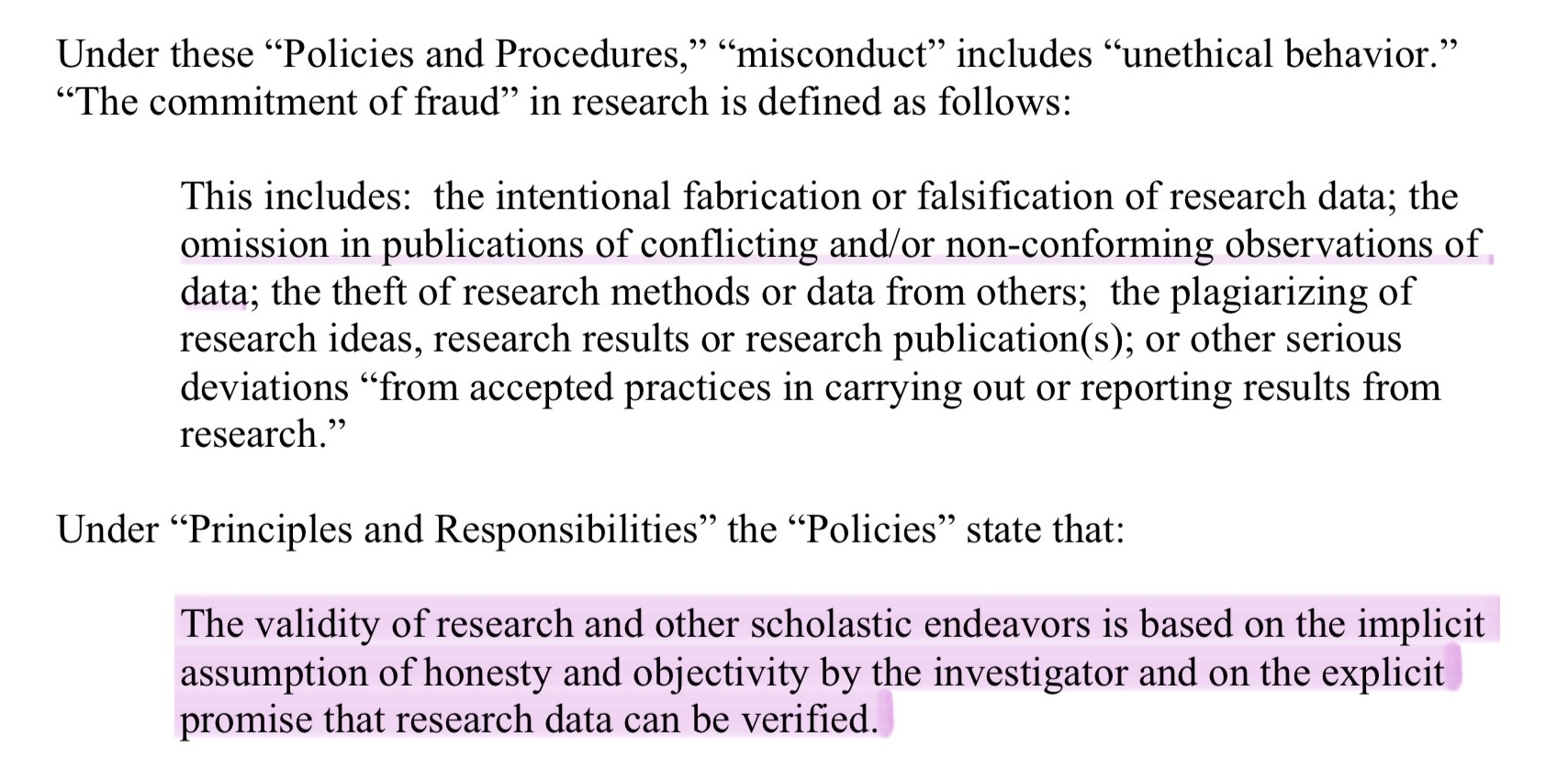
- It’s worth noting that there’s no evidence here that one example of Paul putting obstacles in Brian’s way was “turning up late for meetings.” Not that Mark Lewisohn represents that as anything but his own editorializing, but he’s quite good at leaving the impression that a quote supports his thesis statement even when it doesn’t. It’s very important to emphasize how easy it is for any “historian” to pull this trick, simply because as readers we don’t—and can’t—scrutinize every word choice. The reason all historical associations and university history departments put so much emphasis on historians being transparent is that historians fully comprehend the power of the inherent trust—“the implicit assumption of honesty”—that readers are forced to place in a historian. Readers are forced to trust that a relator of history is telling us of contradictory evidence, we have to trust that they’re representing sources honestly and transparently, we have to trust that they’re not shifting and misrepresenting quotes, because if readers cannot take that on faith, historians cease to have value to society and the historian becomes extinct. The discipline of relating history collapses if we cannot trust The Historian.
But back to John.
John does not seem to be talking about Paul putting obstacles in Brian’s way, but it’s hard to tell what he is talking about, or is supposed to be talking about. Lewisohn is usually quite masterful in sewing these monsters back up, but on this creature the stitches still show. However, working with what he gives us, the most damning part to me is the first line: “Three of us chose Epstein.” If John was truly telling Jann Wenner that only three of the Beatles chose Brian Epstein as their manager, and he meant that Paul was not one of those three, then that would seem to be supporting evidence of at least John’s opinion on whether Paul wanted Brian as manager.
But I can’t help wondering why, if Mark Lewisohn really had evidence of John stating that Paul never wanted Brian Epstein to manage them—if John was emphatic even just one time, let alone always—why serve up this mangled quote that’s so hard to make out? Why isn’t there one single quote of John being emphatic that sounds like English and makes the point in an intelligible way? On most subjects there are multiple John Lennon quotes to choose from, and if he was always emphatic about this, that necessarily means there are multiple quotes of him expressing it.
Let’s look at the sources.
Wenner – 72.1.1:
“Three of us chose Epstein.”
JOHN: “It’s John, George and Ringo as individuals. We’re not even communicating with or making plans about Paul, we’re just reacting to everything he does. It’s a simple fact that he can’t have his own way so he’s causing chaos. I don’t care what you think of Klein—call Klein something else. Call him Epstein for now—and just consider the fact that three of us chose Epstein. Paul was the same with Brian in the beginning, if you must know. He used to sulk and God knows what. Wouldn’t turn up for the dates or the bookings.”
John Lennon, interview with Jann Wenner — Rolling Stone (May 14, 1970)
If this is your first time encountering that quote you might need a moment to process the betrayal. Because you read it right. John Lennon is talking about Allen Klein, not Brian Epstein. “I don’t care what you think of Klein, call Klein something else. Call him ‘Epstein’ for now, and just consider the fact that three of us chose ‘Epstein.’”
There is one part of this quote where John is talking about Brian, but that is the part that Lewisohn surgically removed. And, incidentally, the part that precludes Lewisohn from pleading gross incompetence. He cannot say he somehow missed the fact that John was talking about Allen Klein and not Brian Epstein. He cannot say that he did not mean to deceive us. He cannot say he misunderstood, because he had to cut out the words from Paul’s former bandmate and best friend making that clear, and then stitch everything back together in order to conceal it from us.
Let’s just look at that part of what John said again, and what Lewisohn took his scalpel to.
I don’t care what you think of Klein, call Klein something else. Call him “Epstein” for now, and just consider the fact that three of us chose “Epstein.” Paul was the same with Brian in the beginning, if you must know. He used to sulk and God knows what.
Bold: what Lewisohn took his scalpel to
Hiding that sentence shows deliberation. Hiding that sentence shows intent. Hiding that sentence shows, beyond all doubt, that Mark Lewisohn—universally acknowledged foremost Beatles’ historian—took words from John Lennon—Beatle—that he knew were about Paul McCartney—Beatle—and Allen Klein—a man who never managed “the Beatles” as a group—and misrepresented them to concoct a false narrative of enmity between Paul and the only true Beatles’ manager, Brian Epstein.
Wenner – 72.1.2:
“Paul used to sulk and God knows what.”
He used to sulk and God knows what. Wouldn’t turn up for the dates or the bookings.
John Lennon, interview with Jann Wenner, May 14, 1970 • (for Lewisohn 72.1.2)
Lewisohn chose not to use brackets around [Paul] in this part of his lab created-quote, perhaps because he thought that would be one pair of brackets too many. Or perhaps he was just showing us his most common failing as a historian: extraordinary negligence. You see, he did need a bracket here but did not need one for the next “[Paul]”. I expect he just got the two mixed up because he had more extensive work to concentrate on, and what’s the point of being picky about something small like where a bracket goes when you’ve got serious surgery to undertake?
I do find it mildly interesting that Lewisohn left off “Wouldn’t turn up for the dates or the bookings,” as that would seem to strengthen his case. Although as intimately familiar with the Beatles’ dates and bookings as Mark Lewisohn must be, he would immediately know that with the exception of the Birkenhead booking the following February, this statement is provably untrue—just another John off-the-cuff statement—spoken in anger and without thought, more feeling than fact. And being that this objective and disprovable part of the statement isn’t true, it would tend to discredit the rest.
Robinson – 72.2:
“… [Paul] wasn’t that keen [on Brian]—he’s more conservative, the way he approaches things. He even says that: it’s nothing he denies.”
This source quote is a doozy. A very long John rant in answer to a question about Brian Epstein “packaging” the Beatles. What I’ll do first is show John’s entire answer for transparency and so readers can make a fair and considered judgment, and then I’ll clip off a few sentences surrounding the words Lewisohn uses. One note: there are a lot of ellipses throughout this answer and I suspect they’re used as punctuation for something that would otherwise be a nightmare to punctuate, but I cannot be certain of that. What I am certain of is that they’re in the original, and not added by me.
Q: “I’d like to clear up one of those myths about Brian Epstein ‘packaging’ the Beatles. How true is that?”
JOHN: “Everything is true and not true about everything. I mean, we certainly weren’t naive. We were no more naive than he was. So Epstein was serving in a record shop and he had nothing to do, and he saw these sort of rockers, greasers, seeming greasers playing loud music and alot [sic] of kids paying attention to it. And he thought, well this is a business to be in. And he liked it– he liked the look of it. He wanted to manage us and we had nobody better so we said alright you can do it. Then he went around shopping, getting us work. And it got to a point where he said ‘Look, if you cut your hair you’ll get this,’ for then it was longer than any of the photographs. It was generally cut or trimmed for the photographs– like in your school photographs your hair was cut the day before, or when you had a holiday somehow your parents always managed to cut your hair. But there were some private pictures that show it was pretty long for those days, and greased back, hanging around. But there was a lot of long hair on the teddy boys, the Tony Curtises that grew larger and larger because they never went to the hairdresser. We were pretty greasy. Outside of Liverpool, when we went down South in our leather outfits, the dance hall promoters didn’t really like us– they thought we looked like a gang of thugs. So it got to be like Epstein said, ‘Look, if you wear a suit…’ and everybody wanted a good suit, you know. A nice, sharp, black suit, man… We liked the leather and the jeans but we wanted a good suit, even to wear offstage. ‘Yeah, man, I’ll have a suit!’ So if you wore a suit, you’ll get this much money… Alright I’ll wear a suit. I’ll wear a fucking balloon if somebody’s going to pay me. I’m not in love with the leather THAT much. Wear a suit, you’ll get more money.
“But he was our salesman, our front. You’ll notice that another quirk of life is– I may have read this somewhere– but self-made men usually have someone with education to front for them… to deal with all the other people with education. Now Epstein had enough education to go in and deal with the hobnobs… and it’s the same thing now, if I have a lawsuit, I have to get a lawyer. Epstein fronted for the Beatles, and he played a great part at whatever he did. He was theatrical, that was for sure, and he believed in us. But he certainly didn’t package us the way they say he packaged us. He was good at his job, to an extent. He wasn’t the greatest businessman. But you have to look at this– If he was such a great packager, so clever at packaging products, whatever happened to Gerry and the Pacemakers, Cilla Black, and all the other packages? Where are they? Where are those packages? Only one package survived, the original package. It was a mutual deal. You want to manage us? Okay, we’ll let you. We ALLOW you to. We weren’t picked up off the street… we allowed him to take us. Paul wasn’t that keen, but he’s more conservative the way he approaches things. He even says that, it’s nothing he denies. And that’s all well and good, maybe he’ll end up with more yachts. But we allowed Epstein to package us, it wasn’t the other way around. And the real answer to that question is where are all the other packages? And that goes for all the other myths about people creating us or doing things for us.”
Lisa Robinson interview with John Lennon • Hit Parader (December 1975)
First, “I’ll wear a fucking balloon” is incredible. That’s my favorite John. Also, “Everything is true and not true about everything” is a total Lennon classic.
ROBINSON – SOURCE
“It was a mutual deal. You want to manage us? Okay, we’ll let you. We ALLOW you to. We weren’t picked up off the street… we allowed him to take us. Paul wasn’t that keen, but he’s more conservative the way he approaches things. He even says that, it’s nothing he denies. And that’s all well and good, maybe he’ll end up with more yachts. But we allowed Epstein to package us, it wasn’t the other way around.”
LEWISOHN
John was always emphatic that Paul didn’t want Brian as the Beatles’ manager and presented obstacles to destabilize him, to make his job difficult … like turning up late for meetings. “Three of us chose Epstein. Paul used to sulk and God knows what … [Paul] wasn’t that keen [on Brian]—he’s more conservative, the way he approaches things. He even says that: it’s nothing he denies.”
I am not going to launch into another instructional about the rules of quotation marks, but Lewisohn makes a habit of bracket obscenities, and although not one of his worst liberties, the insertion of “[on Brian]” in brackets makes me want to all caps THAT’S NOT WHAT BRACKETS ARE FOR! (And I have decided, for all our sakes, that as all caps and an exclamation point might usefully replace at least three sentences of reasonable explanation, I will leave them and save us the extra words.) Brackets should not be used to mould a statement into something more favorable to an author’s point.
I have no idea why Lewisohn removed the “but” and replaced it with an em-dash or changed the rest of the punctuation, I only know that he does it all the time and that it should not be done.
So after talking about suits and Brian not being good at business but also being a good manager and how it couldn’t have been Brian that made the Beatles because “where are the other packages?” John says six-ways-to-Sunday that the Beatles “ALLOW[ED]” Brian to manage them. That it was a mutual deal. That they weren’t picked up off the street. And then he says, “Paul wasn’t that keen, but he’s more conservative the way he approaches things. He even says that, it’s nothing he denies. And that’s all well and good, maybe he’ll end up with more yachts.” And then John ends by picking up the primary theme again: “But we allowed Epstein to package us, it wasn’t the other way around.”
John may have meant that Paul wasn’t that keen on Brian, or he could have meant that Paul wasn’t that keen on Klein, or he may have meant that Paul wasn’t that keen on suits. But I suspect “Paul wasn’t that keen” means just that. That Paul is more conservative and wasn’t an all-in, true believer from the first day the way that we know John is with everything. Magic Alex was a wizard, the Maharishi was all-knowing, and Brian Epstein was going to make the Beatles bigger than Elvis. It’s amazing that one of those things turned out to be true, but what John is clearly not saying is that Paul didn’t want Brian as manager, because if he meant that he would have said that. Instead, what John seems to me to be emphatic about is that the Beatles weren’t chumps who got saved by one smart guy, that they had been around the block, and that they made the decision to let Brian manage them—and that he is fully including Paul in making that choice—even if Paul was more conservative and less of an immediate true-believer in the then-unknown quantity that Brian Epstein was in December 1961.
But as it’s impossible to be certain of what John meant, exactly, an ethical historian using this quote properly would solve that problem by simply using more of the quote and letting the reader infer the context. The thing he must not do is add an improper bracket. But the bigger problem with what Lewisohn is doing here is contextual, because this line is surrounded by John stating—emphatically, even—over and over that the Beatles chose Brian Epstein to manage them. That John, Paul and George, at least, “ALLOWED” him to manage them. That it was “mutual.” But as that contradicts everything Lewisohn is trying to convince us of, that is the last thing he will do. Because Lewisohn privileges a deceptive narrative over facts.
And that is the problem that has been inserted into Beatles historiography like a nest of termites.
“It was a mutual deal. You want to manage us? Okay, we’ll let you. We ALLOW you to. We weren’t picked up off the street… we allowed him to take us.”
The one thing that seems inarguable is that what John is most certainly not saying is that Paul presented obstacles to destabilize Brian and make his job more difficult. It is clear that in neither of these two statements referencing Paul—made over five years apart—is John saying anything about Paul trying to sabotage Brian Epstein. And there’s a reason for that, there is a reason that Mark Lewisohn had to manufacture and misrepresent every quote throughout this section: John Lennon never said it.
And so the answer to that problem for a historian is not to manipulate evidence for a manufactured narrative, but to tell a true story that is supported by the words spoken by your subjects and other witnesses. That may seem like it doesn’t need saying, but at this point perhaps it does. Because there are mistakes, which everyone makes, and then there are deceptions. I understand that Mark Lewisohn has been a close friend and mentor to many in the Beatles’ community for decades. I know that the personal ties go very deep, and that you love this man and share memories with him that will bond you forever. This is going to be a severe blow to more than Beatles’ historiography, it’s going to be a severe personal blow to a lot of people, and a personal blow collectively, as well. But the fact is that as Sharon plows through each source, we see that Mark Lewisohn not altering facts is the exception, and somehow we have to face that as soon as possible.
“Notes enable the possibility of replication by colleagues, which helps protect against falsification and fabrication. … The presence of notes, then, helps show that you have not falsified evidence to fabricate a work of historical fiction.”
Tim Lacy (2021 February 23) On the Failures of Historians. Society for US Intellectual History.
THE EVIDENCE: Sharon’s TUNE IN ERROR SPREADSHEET.
ACKNOWLEDGMENTS: It would be remiss of me not to thank and credit AKOM’s Phoebe and Daphne for being the first domino in this investigation. Not only was I first alerted to the “three of us chose ‘Epstein’” quote in Episode 7 of their excellent Fine Tuning series—Spanner in the Works—but they reinvigorated my earlier research into Mark Lewisohn’s citations and supported me, giving my voice a reach it could never have had but for them. I thank them from the bottom of my heart. As for Sharon Dubosky, my partner in crime, I have so much admiration for her that I genuinely cannot put it into words. (At least not in a space this small.) Other than the Thelma Pickles plagiarism section (and the “three of us chose Epstein” quote), all the quotes in this piece were uncovered by her. She is incredible, and none of this would have happened without her. She did most of the work because I genuinely could not keep up with her.

Recommended reading:
Trying to catch up? This might help.
I wrote this back when I thought the bespoke quote creations were the biggest problem, but even knowing what I know now, those Frankenquotes are no small matter and I wrote about why that is, and how Mark Lewisohn was breaking all the fundamental rules of a historian. Somehow, even though we know much more now, it still feels fundamental. (And we wouldn’t be here today without it.)
❦
We find ourselves at a crossroads: the Mark Lewisohn Disaster
Where do we go from here? And how do we keep this from ever happening again?
❦
Designing Lewisohn: Where was Paul? Who could possibly know?
A genuine, late-night Tumblr rant that still managed to show, with one short passage, how Mark Lewisohn twists truth. It’s not long but it’s a revealing instructional.
❦
The Evolving Story of Kim Bennett, Part I: Before Lewisohn by Sharon Dubosky
How does Mark Lewisohn deal with a new, star witness, telling a new story? A different story than he’s told before? Sharon’s rabbit hole is the contract story, and especially Kim Bennett. She’s discovered quite a bit.
❦
Mark Lewisohn rewriting history in the area where we trust him most – songs performed
One very short post that shows Mark Lewisohn altering a set list in a strange way:


It’s not an incorrect citation for the rest of the quote. Is it mix and match, now? Or, it’s Lewisohn, so I guess it is? Look at the link. It’s that interview.
LikeLike
Above, you write that Mark fabricated a line. This is a lie. Here are quotes from the website you listed.
Melody Maker November 20, 1971: “My best playing days were at the Cavern lunchtime sessions. We’d go on stage with a cheese roll and a cigarette and we felt we had really something going. The amps used to fuse and we’d stop and sing a Sunblest bread commercial while they were repaired.“
Sounds November 20, 1971: “My best playing days were at the Cavern, lunchtime sessions, when you’d just go on stage with a cheese roll and a coke and a ciggie, and people would give you a few requests, and you’d sing them in between eating your cheese roll. That was great to me, I think we got something great going in those days – we really got a rapport there, which we never got again with an audience. And if an amp blew up or something, it didn’t matter, because we’d just pick up an acoustic and sing the Sunblest commercial or something – and they’d all join in.“
Now, look at this:
Melody Maker: “I like his ‘Imagine’ album, but I didn’t like the others. ‘Imagine’ is what John is really like, but there was too much political stuff on the other albums. You know, I only really listen to them to see if there is something I can pinch,” he laughs.
Sounds: “I liked ‘Imagine’, I didn’t like the others much. But really, there’s so much political shit on at the moment that I tend to play them through once to see if there’s anything I can pinch.”
And this:
Melody maker: “I think it’s silly. So what if I live with straights? I like straights. I have straight babies. It doesn’t affect him. He says the only thing I did was ‘Yesterday’ and he knows that’s wrong. I used to sit down there and play and John would watch me from up here and he’d really dig some of the stuff I played to him. He can’t say all I did was ‘Yesterday’ because he knows and I know it’s not true.”
Sounds: “I think it’s silly. If he was going to do me he could have done me, but he didn’t. That didn’t phase me one bit. ‘You live with straights’. Yeah, so what? Half the f-king world’s straight; I don`t wanna be surrounded by hobnailed boots. I quite like some straight people, I’ve got straight babies. ‘The only thing you did was Yesterday’. That doesn’t bother me. Even if that was the only thing I did, that’s not bad, that’ll do me. But it isn’t, and he bloody knows it isn’t because he’s sat in this very room and watched me do tapes, and he’s dug it.“
There are more similarities. So, what is happening here? Did Paul give one interview to multiple reporters who then edited his words? Did he repeat himself in two separate interviews? Which one is accurate? Is this website accurate? Does Lewisohn have access to tapes or notes we don’t have? Does this plant any seeds of doubt in your mind? And the biggest question is: Why am I doing the research you should have done before writing this?
LikeLike
In “McCartney Legacy”, there is the story of a Wings Wild Life listening party on November 10, 1971 (p. 319-321). Several reporters are invited. The book cites BOTH the Melody Maker and Sounds interviews AND a tape by Charlesworth. So it is one interview told to multiple reporters edited into different periodicals, and Mark definitely cited the tape because he wanted to write exactly what McCartney said.
LikeLike
Please take down all “evidence” with references to the Sheff quote. See my comment at the bottom of this page of your blog for more evidence that Mark heard the interviews and is quoting from them and NOT fabricating. https://therealtamishow.com/2024/02/01/chapter-16-footnote-8-lewisohn-rewrites-a-foundational-beatles-quote/comment-page-1/#respond
LikeLike
Also, without the [attitude] addition, it would seem like it means that Paul had difficulties learning the instrument, wouldn’t it? That would not be accurate at all. Doesn’t the added word make it more concise?
LikeLike
The “coke and a ciggie” etc., is from a November 20, 1971 Sounds interview by Steve Peacock. This was an incorrect citation by Mark, not a fabrication. https://www.the-paulmccartney-project.com/interview/interview-for-sounds/
LikeLike