–NOTE– For those just arriving to this man-made disaster: On January 3, 2023 I posted my essay “A BEATLE DIDN’T SAY THAT” and on January 15th Sharon Dubosky contacted me. She immediately began plowing through sources and recording her findings on an ever-expanding Tune In Error Spreadsheet. As of May 11, 2024 she had checked a total of 544 citations and recorded 212 major errors.
“The only obligation we owe to history is to rewrite it.”
—Oscar Wilde
This historical disaster is going to take a long time to recover from, but it never could have happened if Beatles’ knowledge was not so siloed and held in so few hands. It not only keeps almost everyone out, it makes it incredibly difficult for the public to check sources and keep authors honest. This is a cataclysm for Beatles’ historiography, and it’s a cataclysm that could have been avoided if primary sources had not been treated like secret treasures that only the special few were allowed glimpses of. Holding knowledge for power over a story as culturally and musically important to the entire world as the Beatles’ story should be something that is shamed and shunned, but holding knowledge for power over this story is not only what exactly Mark Lewisohn has continually and consistently done, but something he even regularly brags about. And strangely, no one seems to have realized how dangerous it was. Holding and hoarding the sources of history is a dark, selfish, stifling inclination, and it is not what the Beatles were about. The idea of monopolizing knowledge is antithetical to everything the Beatles’ represent, and I don’t believe it’s how Beatles’ fandom thinks. I think it occurred slowly and naturally, and good people just got tunnel vision.
Unfortunately, this is our wake up call.
The way I see it, the way forward requires three things.
One. We need to take Beatles’ history seriously by having people who care about it guide it and guard it. We need guidelines and standards that we expect each other to abide by, and an association of Beatles’ scholars dedicated to preserving Beatles’ history.
Two. We need to free and share the knowledge. Beatles’ sources need to be digitized en masse. Beatles’ historiography needs to be democratized and accessible to anyone who wants to tell the story.
Three. We need a commission to investigate how this happened and to put forward recommendations to keep it from ever happening again.
One.
Attention matters.
We need a voluntary group (that anyone can join)—similar to the American Historical Association or the Royal Historical Society—dedicated to setting and preserving the goals, standards and best practices of Beatles’ historiography. Not a policing organization, but an organization that articulates and guides. That makes things plain and makes it harder to falsify history simply because the standards are clear and ones’ peers are watching. We need written principles for what we want, what we expect from one another, and what standards of scholarship will best preserve Beatles’ history and make Beatles’ scholarship flourish into the future. Because that’s the answer. A big, brilliant, flourishing garden of Beatles’ knowledge is the answer.
Which brings me to the second and at least equally important reason some sort of Beatles’ Scholarship Society is long overdue: connections and mentorship. I preach a lot about sharing the knowledge and I mean it in every way. I am obsessively serious about making Beatles’ resources easily accessible, but I also am deeply covetous of the human knowledge of so many of you. Not a week goes by that I don’t wish I could ask a question of one Beatles’ author or another, and more often than not they are very Beatles’–research specific questions that probably only four or five people on earth could answer. How do I proceed now? How would I find this? What would you do?
Some—many, even—of the skills of Beatles’ journalism and research are identical to reporting on any other topic, but many are not. The idea that any work of history on the Beatles’ will be the last and final word—that you can call “FREEZE” on history—is as futile a hope as it is a dark one, and the way to influence future historical works is to influence those who will be writing them. There is nothing more pure and empowering than seeing someone breathe new life into a story because you helped them.
And look, I get that we cannot judge past Beatles’ bios by the standards we aspire to now. Beatles’ “sources” have evolved from the stuff of scrapbooks and are now moving from the stuff of collectors to the stuff of museums. In the same way, Beatles’ scholarship is shifting from entertainment journalism to a topic of serious historical accuracy, and it’s more than cliché or excuse to say that we cannot judge what came before by the standards of what we aspire to in the future or even expect today. But there is one crime, one cardinal sin, that reaches fairly into the past and will endure into any future: willful deception. I hope that from this moment on Frankenquotes become extinct, but there is a big difference between a combo quote that retains the original meanings and one spliced together for the purpose of creating a new meaning.
Two.
History cannot be hoarded.
Free the knowledge. We need to digitize and share everything. We need a big, collective push to make access to all Beatles’ primary sources as universal as possible. Let’s create a digital archive for the ages. Let the Beatles change history all over again through their fans. Let’s give the Beatles a second life by connecting all these disparate bits of knowledge in one place so anyone with an internet connection can pick up any Beatles’ puzzle piece they want. Imagine what we can all gain by a storehouse of collective wisdom. Mark Lewisohn always says that the Beatles stood for truth, but to me they were magical because they were better shared. The Beatles connected people, and that’s been fundamental to them from the start.
Moreover, this historical disaster never could have happened if sources had not been hoarded, and there’s just no reason for it. Beatles’ fans and collectors are not selfish people, and you can keep your special things and share them at the same time. Let everyone learn from them and get joy from them. There are so many Beatles’ books and so few digitized. Books are better shared. Documents are better shared. Ticket stubs are better shared. Share it all. Hiding your treasures from the world robs them of powers yet unknown, and makes us all poorer.
More pertinent to the situation we now find ourselves in, hoarded collections are what have allowed so few to have a chance to tell this story, robbing it of so much that can never be gotten back. It has stifled learning and stifled this brilliant and joyous history that is so important to us all. It has had the effect of erecting an enormous castle wall around this history that keeps almost everyone out, and it is exactly that castle wall that has landed us here.
I invite you to take up your pickaxe and help tear down the wall.
We should all have a zero tolerance policy for the hoarding of knowledge. It’s grotesque. There is no defense of it that would not be reprehensible to the ears, mind, and conscience. The only way to preserve Beatles history—but more importantly, the only way to uncover that history in the first place—is to make it accessible. Universal. Free. The more people who can reach and tap into it, the more it can be understood. And the more it is shared, the more it is preserved. That is the only thing that ensures its survival. How can any of us really know anything real when bits of knowledge are broken up, siloed, and scattered? That is a recipe for the smothering of truth and the death of wisdom. Knowledge monopolized is knowledge doomed to perish.
Keep the thing. Share the source.
–Mark Lewisohn ❦ “a art da biografia” • (April 26, 2024)
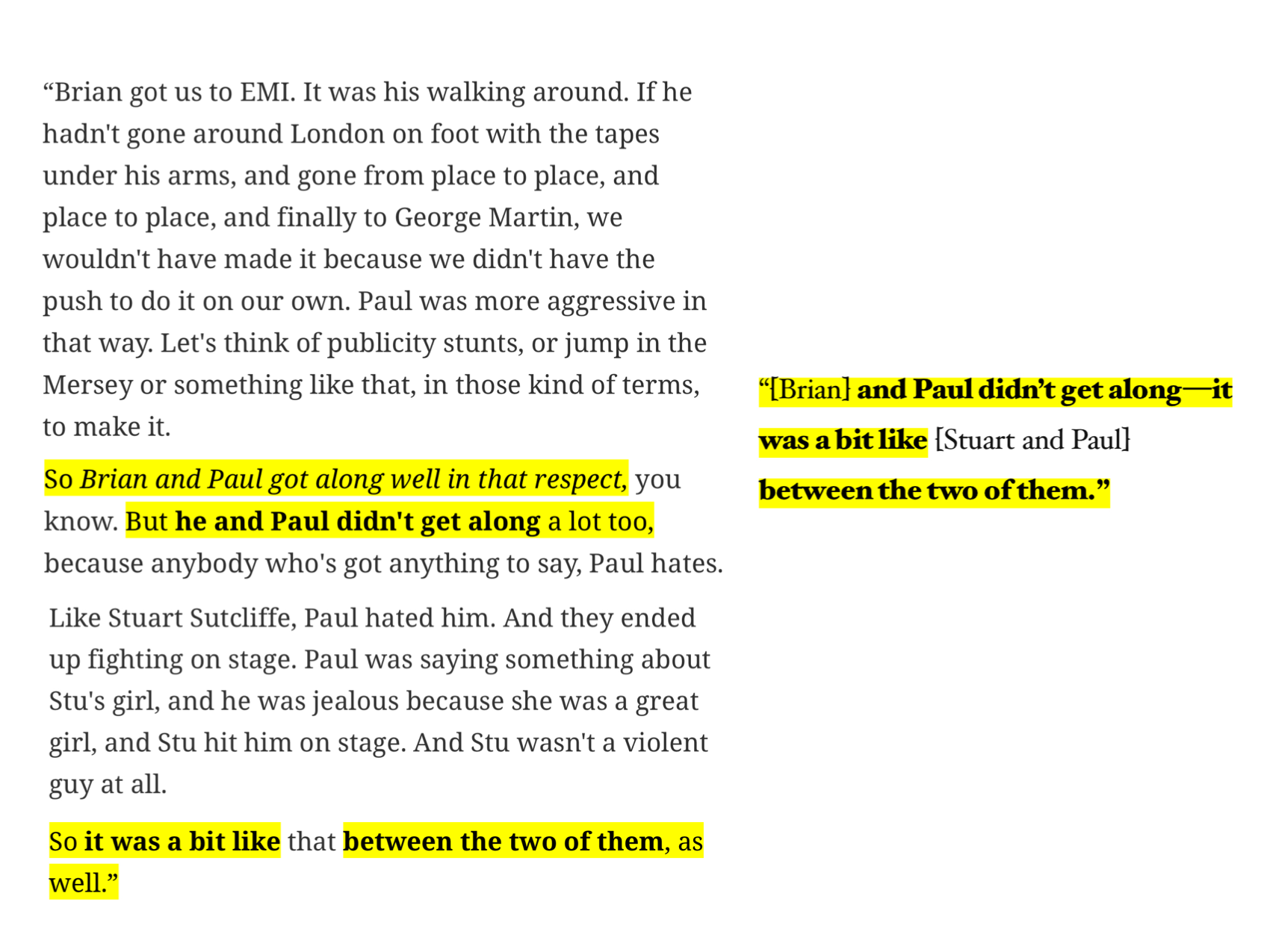
I swing between frustration and empathy when I think of where we are and how we got here. I feel deep empathy for all the friends of Mr. Lewisohn who will be hurt and all the authors whose work will be blown up by the fraud he has perpetrated. But it is impossible to spend months scrutinizing Mark Lewisohn’s citations, coming across one after another fabricated or otherwise misrepresented quote, and not feel immense frustration that it has taken a decade for a few women, working alone in our free time, to check this work that vast numbers of a community have been relying on, on faith. I feel betrayed. At first, I just felt betrayed by Mr. Lewisohn, but lately I have begun to feel a sense of betrayal on a broader scale. I feel like there was a more general obligation to protect this history, and knowing that one man was basically nominated to be entrusted with it, there was a higher duty to ensure that he was getting it right. We have to be honest with ourselves, and as you can look now and see that what we are representing is true—you can check the citations for yourselves—hindsight must be, and probably should be, at least a little painful. Because Mark Lewisohn’s entire pitch has basically been: “I have a monopoly on Beatles’ knowledge by divine right and more swag,” and unless I’m missing something, everyone just nodded along. As a reluctant scholar of his interviews, I know he is always quite clear about the fact that he’s the only one who has talked to a bunch of dead people and he’s the only one with all the documents and so he is the only one who can tell the Beatles’ story. Generally when someone starts saying that they are the only one who can know something—that truth is for them alone to define—it’s usually time to get nervous, but apparently it’s been Lewisohn’s schtick for ages and still goes over well. As a Lewisohn interview expert, I can testify that the three constants of a Lewisohn appearance are reliably, “the Beatles stood for truth and I want to match that truth,” a handful of “the Beatles’ almost didn’t happen” anecdotes, and a heavy dose of “you have to trust me alone to tell this story because I’ve got all the relics.” I mean, the man literally has a tour where Beatles’ fans pay to see his super secret treasures and hear him whisper what they really mean. (NO RECORDING!)
Shockingly, “the people in this room get more knowledge than the rest of you because we heard it straight from the oracle who shared his secrets with us” is not a recipe for scholarly success.
And while I absolutely do not blame anyone for wanting to go to these shows—I would want to go—I do hope that there’s a realization now of the inherent dangers of this model in terms of protecting history and getting the truth. The truths. Because there are so many stories and so many truths imbedded in every history, depending on the questions different people ask. The goal should always be to broaden our lens, and anyone seeking to narrow it should be viewed with suspicion. You can’t be greedy with history. Historians are reliably encouragers of sharing primary sources and of wanting more people telling historical stories from more points of view. Until Mark Lewisohn, I had never encountered someone calling himself a historian who regularly said that he was the sole person qualified to impart a history, and it was my first red flag.
“The reason all historical associations and university history departments put so much emphasis on historians being transparent is that historians fully comprehend the power of the inherent trust—‘the implicit assumption of honesty’—that readers are forced to place in a historian. … The discipline of relating history collapses if we cannot trust The Historian.”
—From “A TENDENCY TO FABRICATE HISTORY”
Three.
An honest assessment.
We need a commission to take a hard look at what went wrong, to write a thorough report, and to recommend guidelines to keep it from ever happening again. How much of the secondary and tertiary issues of this disaster they should take up is something I cannot even fathom now. So many other books rely on Lewisohn, and especially rely on some of his most warped and deceptive narratives, that the fallout is going to be vast, and may never be fully repaired. It’s also daunting to think that to my knowledge no one has looked at any of his other books, and that there’s so much that is uncheckable. I hope that Mr. Lewisohn will share his documents and recordings of his interviews, which would help us to, perhaps, separate some of the wheat from the chaff. However, it’s important to emphasize that it’s not just the altered quotes that are at issue. They’re the easiest to look at and render some sort of verdict on, but in many ways it’s the broad misrepresentations of other sources and unsourced claims that present problems, and at this point it’s hard to see how one would begin to untangle it all.
“I need to do the book, the history” – “I just decided this has to be done really properly…” – “…it’s very important that I write this book now, because otherwise it will be wrong forever. And the primary reason for me doing it is to ensure that it’s right… if I don’t write these books it will be wrong forever. It will be misunderstood forever … and it’s only really me who’s really out there trying to get it right. …” – Arte da Biografia (April 26, 2024)
Mr. Lewisohn chose the standards by which he was to be judged. I don’t think that inventing quotes from Beatles’ would be acceptable or accepted by any standard, including an “entertainment journalism” standard, but from the beginning he was very intent that Tune In be seen as a serious work of history. In almost every interview I’ve encountered from the year after the book’s release he stresses the verifiability of his sources and quotes. He repeats the word “transparent” again and again. He wanted a sea of endnotes, and that ocean of citations has been a useful prop to his credibility. Mark Lewisohn has been asking us to judge him by his citations for over a decade. He chose this measuring stick, and even if he hadn’t, it’s the deception that sinks him. Once you start examining the sources it is impossible to escape the dishonesty that pervades the work. Sometimes it is calculated and obvious—to shift a narrative—but it is the constant inconsequential changes that sink the ship. And if you begin looking for yourself, I believe it will be the consistency and brazenness of the license he takes on those less pivotal quotes that will change how you see this book. It is simply not acceptable to dress up the facts—to spruce up the quotes of your subjects to make them sound better, to shape the words of any person you are writing about into something new—just because you can. Just because your readers trust you. Mark Lewisohn has taken the trust we place in historians and that we have placed in him and he has used that trust against us.
“The validity of research and other scholastic endeavors is based on the implicit assumption of honesty and objectivity by the investigator and on the explicit promise that research data can be verified.”
From Emory University’s “REPORT
of the Investigative Committee in the matter of
Professor Michael Bellesiles” – Up until now, the largest scandal of a historian falsifying research

There is so much more that needs to be said, but here I will only add a few more points. First, an answer to the question some might have about whether Mark Lewisohn knew the rules about how quotes work. It seems an absurd question to my mind, because this is the man the vast majority of an entire community named as the primary—if not the sole—person entrusted with Beatles’ history, and not expecting him to do his due diligence would be a sad reflection. Nonetheless, we have solid evidence that he should have known, and it’s evidence that comes straight from his own website, from the quote he features front and center on his header.
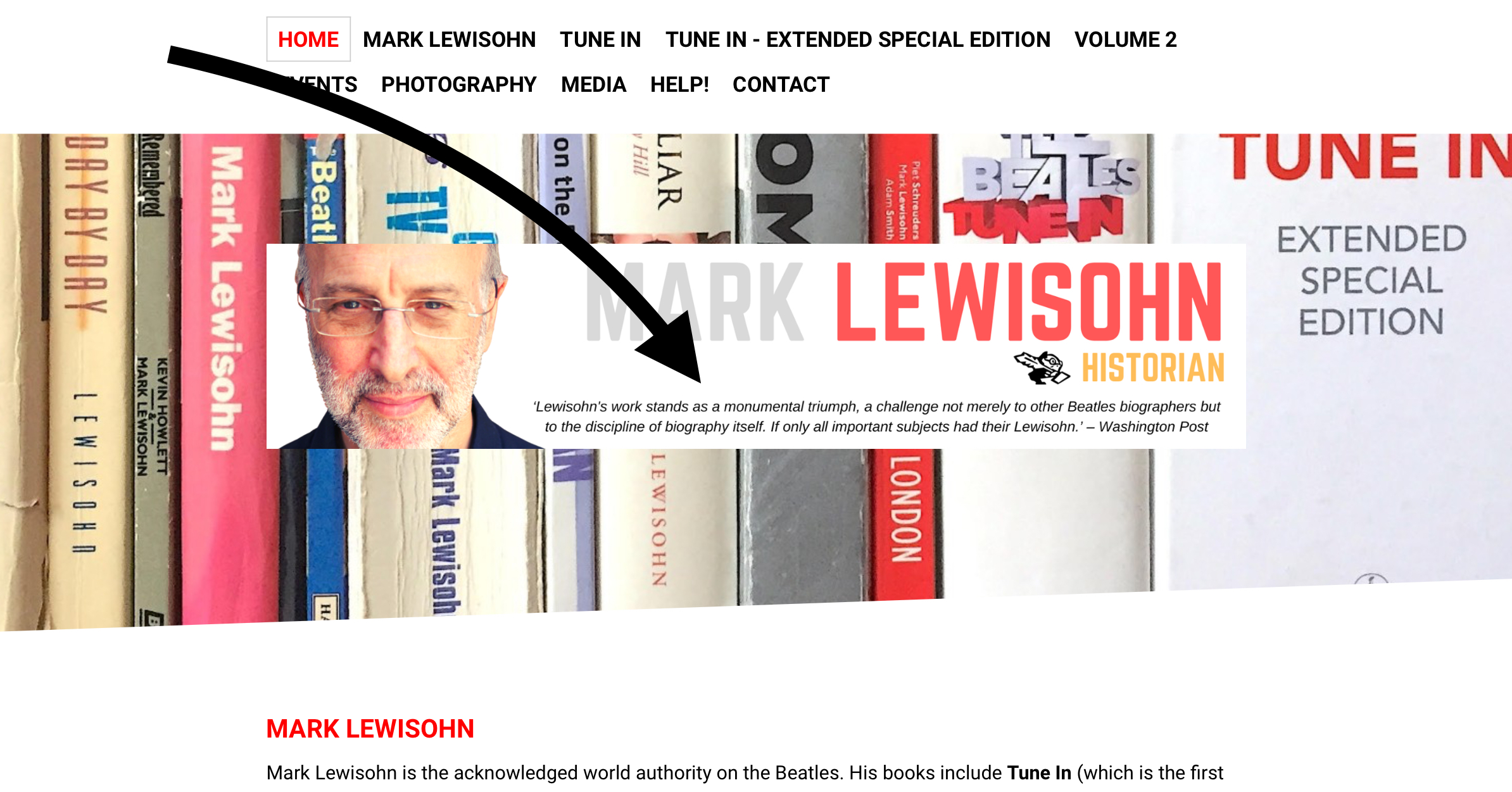
Here is the fuller quote, from James Rosen in the Washington Post, January 10, 2014.
In totality, Lewisohn’s work stands as a monumental triumph, a challenge not merely to other Beatles biographers but to the discipline of biography itself. Let all practitioners demonstrate the monastic devotion on display here. If only all important subjects had their Lewisohn.
Rosen, J. (2014, January 14). Three Beatles’ books. Washington Post. • archived Washington Post link
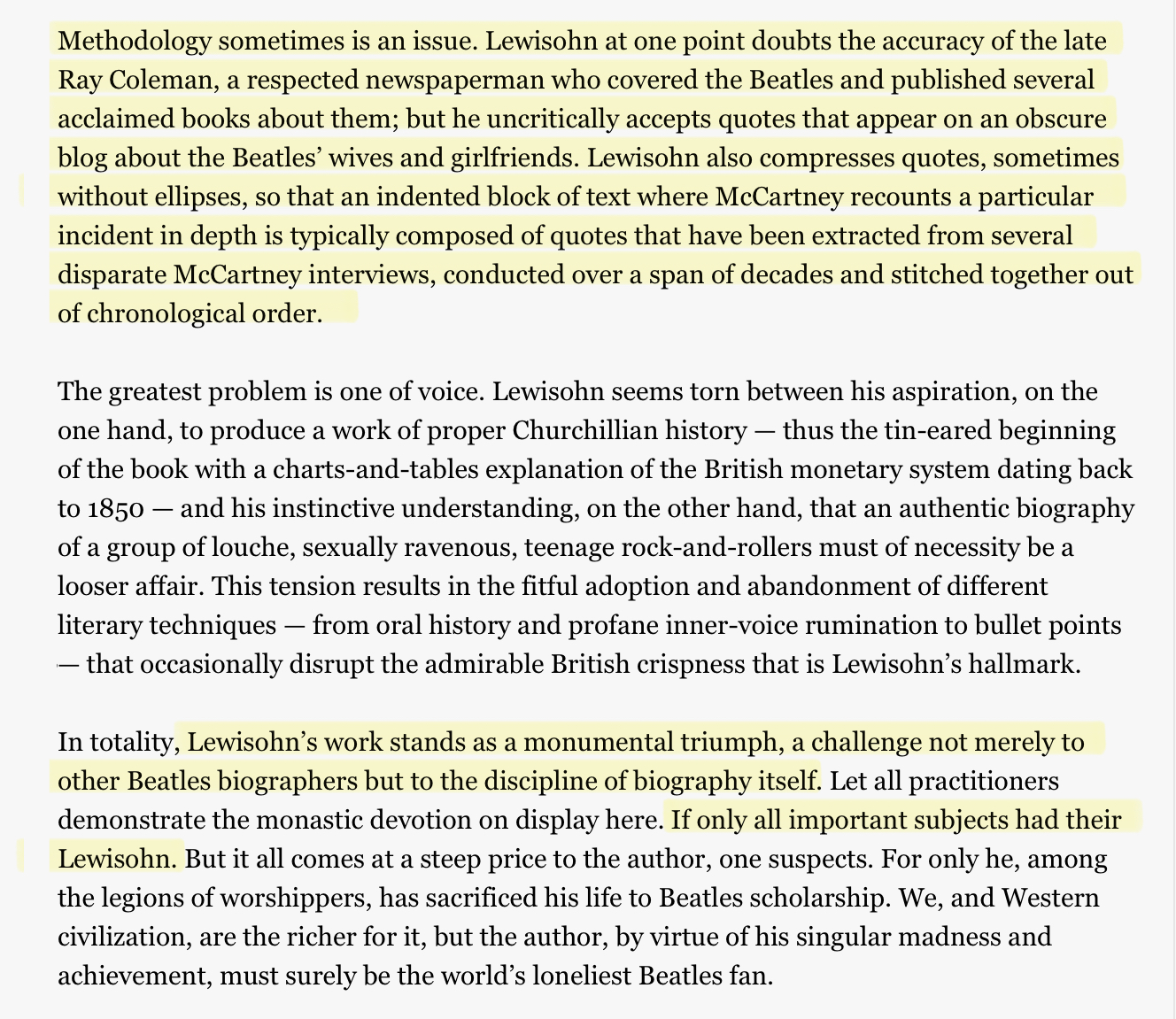
But separated by just one paragraph from his featured excerpt is this canary, warning of problems to come:
Methodology sometimes is an issue. Lewisohn at one point doubts the accuracy of the late Ray Coleman, a respected newspaperman who covered the Beatles and published several acclaimed books about them; but he uncritically accepts quotes that appear on an obscure blog about the Beatles’ wives and girlfriends. Lewisohn also compresses quotes, sometimes without ellipses, so that an indented block of text where McCartney recounts a particular incident in depth is typically composed of quotes that have been extracted from several disparate McCartney interviews, conducted over a span of decades and stitched together out of chronological order.
–archived Washington Post link
❦
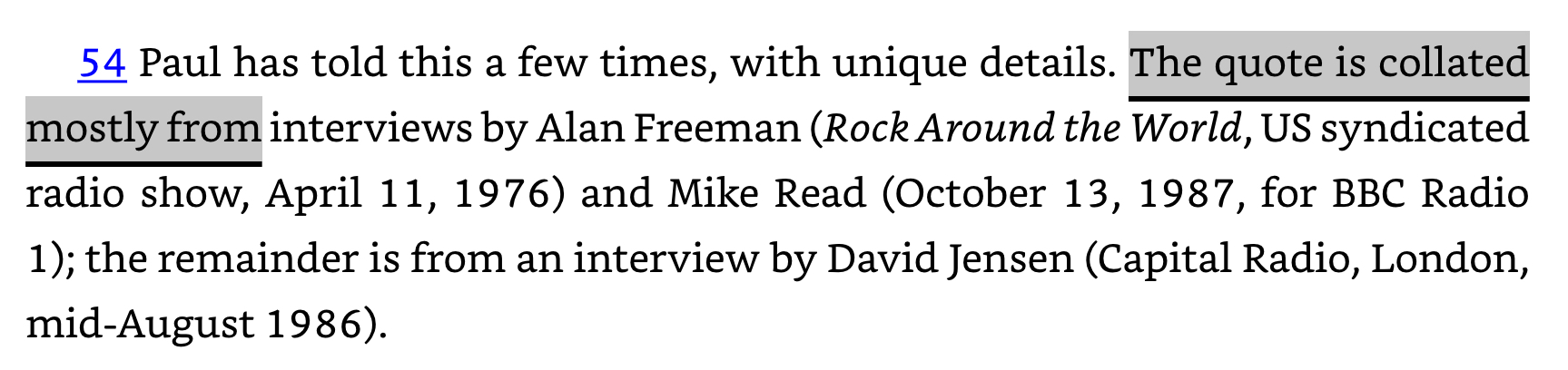
And much as I don’t want to rail on a community that I love and that already has so much to deal with, there have been sirens blaring for a very long time. To my knowledge, almost no one who has interviewed Mark Lewisohn has asked any truly difficult questions, and there is one egregious error that I am most surprised no one has ever asked him about. An error that, according to the Senior Charity Officer of the Penny Lane Development Trust, has contributed to a great deal of trouble in Liverpool. And it’s just one of multiple errors that we can see reproduced and spread simply in the reviews of his book.
In Tim Riley’s December 6, 2013 New York Times review, he repeats the unforgivably sloppy and unquestionably false assertion that Mark Lewisohn negligently dropped into his be-all, end-all Beatles’ biography about Penny Lane being named after the slave ship captain, James Penny.
This edition has a lean, polished feel that could make the curious itch for more, and Lewisohn’s obsessive scholarship offers provocative details, like this one, dropped casually into a footnote: “Like Penny Lane, Mathew Street is named after a slave-ship captain.”
Pre-Fab Four – New York Times (archived link)
Dropped “casually” is the problem. How do you write something that explosive without some due diligence? According to Richard MacDonald, a historian who has devoted extensive time to this issue, the earliest known mention of a name to the road was in the 1840’s, when it was referred to as “Pennies Lane.” James Penny died in 1799 and already had a road named in his honor—Arrad Street—named for his birthplace. MacDonald is certain that Penny Lane is in no way named after James Penny.
But just in the reviews of Tune In, there are other less pivotal Lewisohn falsehoods repeated, and always as examples of Mark Lewisohn’s exacting research. In the Guardian Observer review:
This is a textbook; but that is no barrier to enjoyment. There are academic-style endnotes, in which virtually every statement is substantiated by a primary or secondary source, and footnotes on minutiae – such as how many different ways Mersey Beat, the local scene’s paper, misspelled “McCartney” in 1961. The detail extends to Jim McCartney asking his son Paul whether his bowels have moved on the day he sets off for Hamburg.
Tune In review by Kitty Empire in the Guardian Observer, October 19, 2013

The Tune In section referenced in the review:
In Allerton, at 20 Forthlin Road, Jim Mac ensured his son had enough cod liver oil capsules for two months, and inquired (as he did most mornings) whether the boy’s bowels had moved, then he gave him an Englishman’s pep talk, making him promise to be a good lad, stay out of trouble, eat proper meals and write often.
Tune In, p345 – Cited: (15-51) Davies, p77
The cod liver oil capsules detail seems wholly invented and is most certainly not in Davies, the source cited. But yesterday Sharon got a book I’ve been coveting a very long time—as the prime areas I’ve focused on cite it liberally—Pete Best’s Beatle! And it turns out that Lewisohn may have picked up part of this strange color from Pete’s goodbye before Hamburg.
Before setting off for the ‘Fatherland’ there were, naturally, the usual maternal warnings about looking after yourself and keeping your bowels regular and making sure that you always had enough to eat.
Pete Best, Beatle! p29
I don’t know why it took four women working, unpaid, to finally do this fact-checking, but in the end, it fell on us and once we saw the problems we felt an obligation to continue. We cared. But it has been a weighty task, and it has taken a toll. I don’t know what comes next or how we will be treated. What I do know is that this is a heavy blow for the whole Beatles’ community and that there is a lot more work that needs doing, but that it is also a chance for us to come together, inclusively, and start afresh. It is a chance to live up to our highest ideals. I get no satisfaction from this disaster. It’s horrible on every level, but perhaps something positive can be created from these ashes. I hope that the Beatles’ community lives up to my belief in its good nature, good faith, and earnest desire to get it right. It will be difficult, but I believe we can come out better on the other side. I genuinely do.
Sharon Dubosky’s Tune In Error Spreadsheet
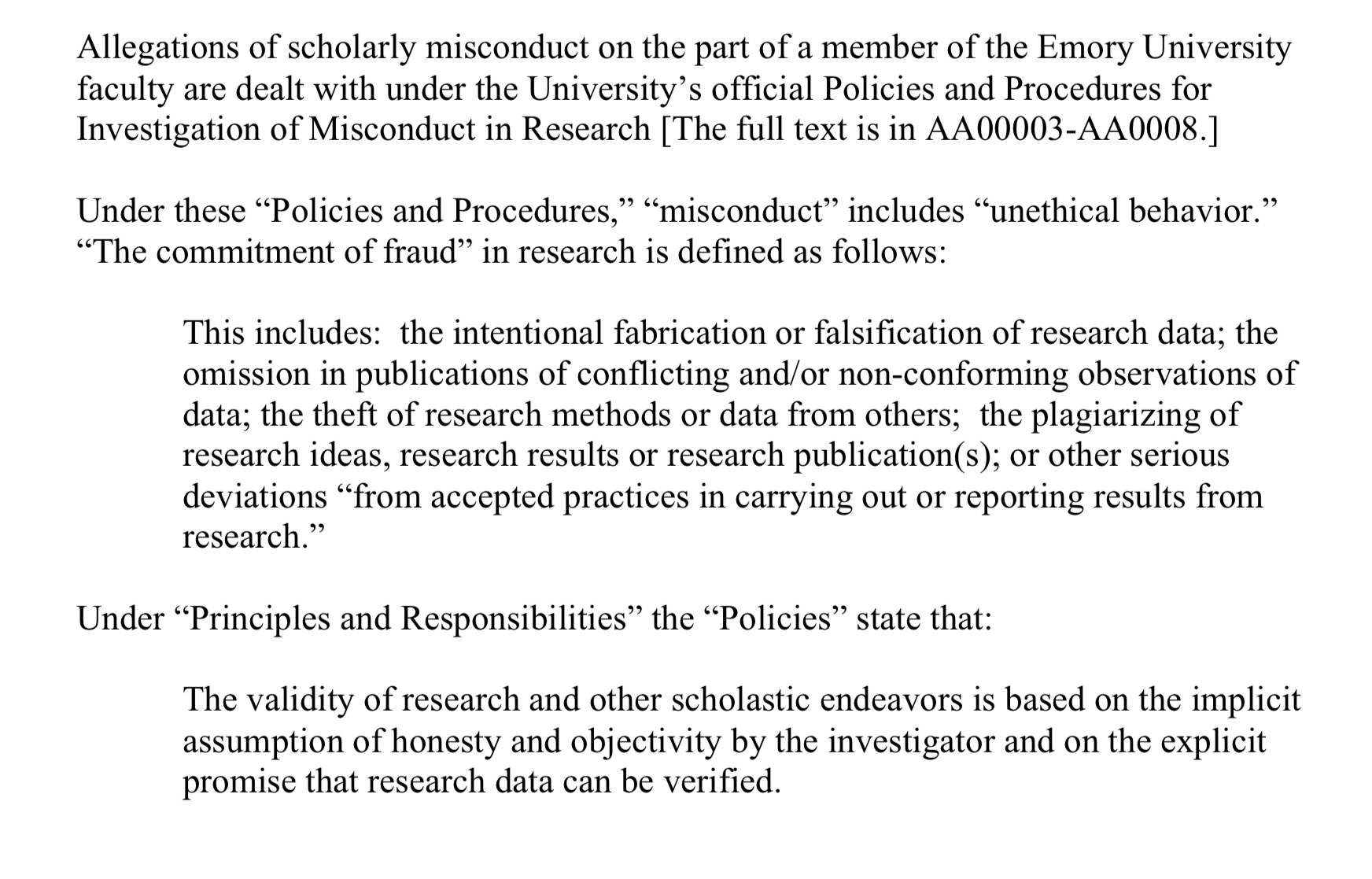
“‘The commitment of fraud’ in research is defined as follows: This includes: the intentional fabrication or falsification of research data; the omission in publications of conflicting and/or non-conforming observations of data; the theft of research methods or data from others; the plagiarizing of research ideas, research results or research publication(s); or other serious deviations ‘from accepted practices in carrying out or reporting results from research’.”
A Funny Way of Looking with Michael J ❦ The Beatles with biographer David Bedford (July 14, 2023)
ACKNOWLEDGMENTS: It would be remiss of me not to thank and credit AKOM’s Phoebe and Daphne for being the first domino in this investigation. They did a ton of research for their excellent Fine Tuning series, reinvigorated my earlier work into Mark Lewisohn’s citations, and supported me. I thank them from the bottom of my heart. They gave my voice a reach it could never have had but for them. As for Sharon Dubosky, my partner in crime, I have so much admiration for her that I genuinely cannot put it into words. (At least not in a space this small.) She is incredible, and none of this would have happened without her. She did most of the work because I genuinely could not keep up with her.

Recommended reading:
A Tendency to Fabricate History
Designing Lewisohn: Where was Paul? Who could possibly know?
The Evolving Story of Kim Bennett, Part I – by Sharon Dubosky

 Exact Words
One Comment
Comments are closed.