
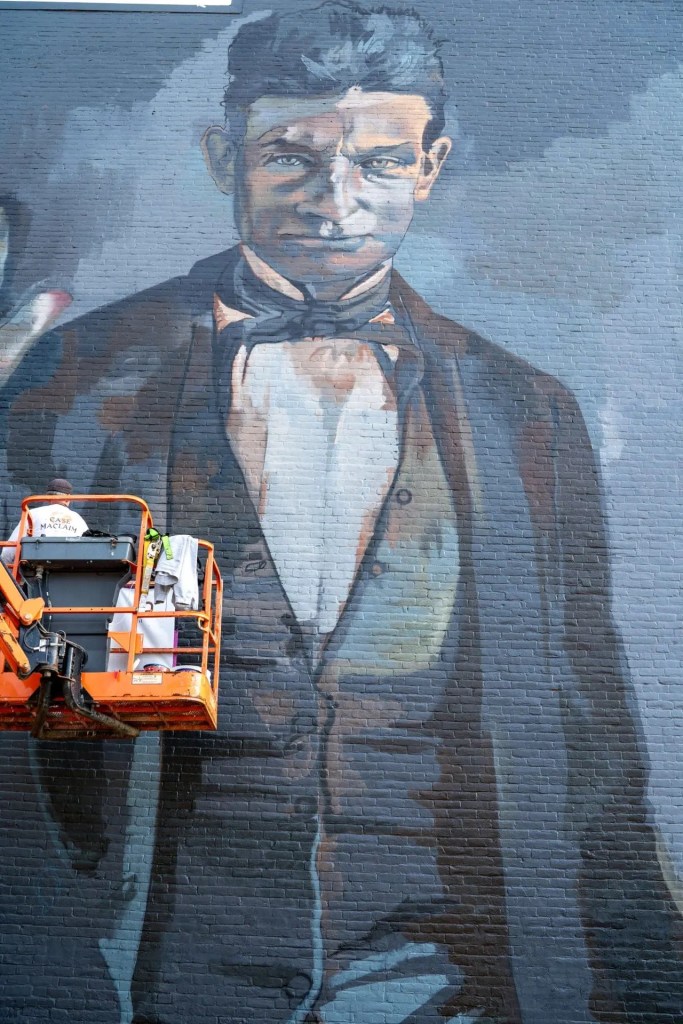
In Holyoke there is an incredible mural of John Brown, created by a German artist, CASE Maclaim. What always catches my attention is the flag. It’s a blur, and perhaps it represented a flag that pointed to the Subterranean Pass-Way. But perhaps it didn’t. And sometimes I wonder, did someone just color it in later? It almost looks like it. Either way, it always makes me think of John Brown and the American flag, and the battle Brown won at the Chatham conference in Canada over fighting under the American flag, a point he would not budge on.
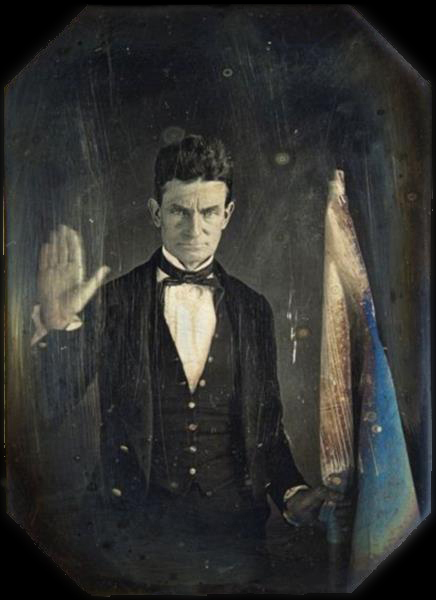
It’s easy to understand why any African American, escaped from the day to day, exhausting evils of slavery would want nothing to do with the flag that the very men who had imprisoned them revered. The influential Black Canadian, Martin R. Delaney recorded that at the Chatham Conference the flag was the only real sticking point between Brown and the group of mostly former enslaved men. Delany puts it in the most powerfully tactile way: “Too many of them thought they carried the emblem on their backs.”
I must admit, sometimes even I need the jarring reminder of the inescapable physical realities that the men and women who endured the most horrific systemic cruelty ever known to history carried with them and could never escape. Looking into the eyes of Frederick Douglass I see the distilled fierceness of a man who has no intention of forgiving and forgetting, and it’s easy to imagine that a similar condensed ball of fire stirred in the spine of many an escaped soul. To consent to fight under the flag that their greatest enemies reverenced must have been a bitter pill, and if John Brown had been a less persuasive man, they might never have been brought around to accept it. But Brown was persuasive, and every time I see that impressive mural, I think about what an important decision the choice of the flag turned out to be.
Because even John Brown’s enemies respected him. They couldn’t help it. But if he had been flying anything but the American flag, I think all their grudging respect, written in report after report, could never have found enough oxygen to surface at all, and nothing else he said or did would have mattered. That one single symbol was vital. Not that Brown would get any credit for its use, but flying any other flag would have instantly tarred him as a real traitor, and would have altered the story in such a way to destroy the entirety of it.
It is the simple things, like flags, that often wield the most power in mens’ minds, and John Brown was a master of impression. He knew what worked. He seemed to almost instinctively understand how broad acts filtered down into the populace, and as time went on, we can see him also clearly thinking about these things, and altering his actions to focus more and more on using his image to shape public opinion.

Photo by exelbierd 105
Speaking of focus, John Brown was the first historical figure that I ever focused on. As a child—approximately eight years old—I had reason to encounter Thoreau’s The Last Days of John Brown, which led me on to Ralph Waldo Emerson’s speech on him after his death. After reading both of those men, there was no way that any petty biographer could convince me that John Brown was bad, although at the time Brown’s historiography had entered into the “he was a madman” phase. I trusted Emerson and I trusted Thoreau, and had little respect for the idiots I was able to dig up in the library, the nobodies who thought they could convince both history and me that Brown was just a crazy man.
And then, finally, I was pointed toward DuBois, and the real study began. I still go back to DuBois, again and again, and think that in the end, he is still the best biographer of Brown.
Yet John Brown always gets flattened out into an icon. He understood how easily he could become iconic and used that to its fullest, but we keep stripping him of his humanity, and it is his humanity that made him great. Without that, the rest never would have been.
I am not here to deny that John Brown was very pissed off or to try to make him into some sort of pacifist. I don’t want to dilute any part of his vibrant personality. The best men and women are always far more than just one thing, and John Brown was, in my opinion, one of the very best men that ever walked the earth. Not perfect, but not just a killing machine, either. He loved deeply, and was incredibly empathetic. Every single soul who came in contact with him was impressed with him. And I do mean every single soul. The men who killed him and even his prisoners liked him. Genuinely liked him. He had a rule in his gang—all the rules were written down—that you had to be kind to prisoners. Not just that you were not allowed to hurt them, but that you had to be kind to them.
When John Brown lay wounded on a cot in the Charlestown prison, he was interviewed by Senator James Mason of Virginia and Representative Clement Vallandigham of Ohio, but many others gathered around him and commented as the interview progressed. It is one of Brown’s most impressive moments. There is nothing anyone can ask him or challenge him with that he does not calmly and civilly crush them with. Senator Mason asks him, “How do you justify your acts?”
If you want to know the John Brown I know, it is here where you will meet him. On his cot, wounded and bleeding, he is somehow more solid than all his interrogators put together. His answer to Mason is part answer, but more simple statement. A warning. His Due North is more reliable than any compass I have ever encountered. There is something dense and unflappable about him, and he manages to tell Mason he’s going to Hell if he doesn’t change his evil ways, and without offending the senator. That was Brown’s gift. When he released prisoners it was as if they couldn’t wait to tell someone the kind of man Brown actually was. Often times they complained that they had to eat with Black men, but that always quickly melted into talking about how impressed they were with the man himself. As one released man stated—after saying Brown was the best man he ever met—that he “knew more of the Bible.”
So Brown’s answer to Mason is not surprising, nor is the fact that however Brown spoke the words, they didn’t offend the Southern Senator.
“I think, my friend,” said Brown, “you are guilty of a great wrong against God and humanity. I say it without wishing to be offensive, and it would be perfectly right for anyone to interfere with you so far as to free those you wilfully and wickedly hold in bondage.”
Then he adds, “I do not say this insultingly.”
Mason hadn’t been offended. “I understand that,” he says.
But John Brown, his Due North rising to the top again, adds again that he knows he did the right thing. His conscience is clearer than that of any of the men who had pushed in around his cot: “I think I did right,” Brown says, “and that others will do right who interfere with you at any time and at all times. I hold that the Golden Rule, ‘Do unto others as ye would that others should do unto you,’ applies to all who would help others to gain their liberty.”
But when Senator Mason asks what wages Captain Brown offered to his soldiers, Lt. J.E.B. Stuart—who would soon be gaining glory in the eyes of the South on the battlefield for the Confederate forces—decided to break in with an impertinent, “The wages of sin is death”, and Brown didn’t hesitate to criticize him. John Brown always expected a lot, and Stuart had stooped below his ideal of how men should treat one another.
“I would not have made such a remark to you if you had been a prisoner, and wounded, in my hands,” Brown calmly shot back.
There is something so simple, yet substantial, in Brown’s censure of the young Lieutenant, that it is easy to forget that Brown lay bleeding on a cot. He is their prisoner. Yet somehow he seems bigger than anyone else in the room.
But when Senator Mason followed up by asking if “this talking annoys” him, Brown was back to due North.
“Not in the least,” he cooly responded.
❦
One thing that gets lost in the tales of Brown is that he loved to sing. He sang with his family and sang to his children.
“Father used to hold all his children while they were little at night, and sing his favorite songs,” said Ruth Brown, his eldest daughter. “He sometimes seemed very stern and strict” she said, “yet his tenderness made me forget he was stern.”
When his youngest daughter was sick, Ruth said that he would walk the floor with her for hours and sing to her, night after night. Of course, the sick child soon learned his step, and if he came home from work in the day and didn’t have time to take her he would have to tip-toe so that she didn’t cry for him.
“I used to be charmed myself with his singing to her,” she told Franklin Sanborn.
“He noticed a change in her one morning and told us he thought she would not live through the day, and came home several times to see her.”
Finally, the little girl heard his voice by her bed and lifted up her hands for him to take her, and he walked the floor with her until she died in his arms. “When she was buried father broke down completely and sobbed like a child,” Ruth said.
Another thing that breaks the spell of Brown as simply the iconic, angry, killing machine is that when they lived in New York he tucked his father in every night. Every single night.
I am not trying to erase the fact that John Brown was very pissed off about slavery. But he was a whole person with deep empathy. And if you find yourself liking him, remember that you’re not alone. I’ve yet to come across a single human who encountered him who did not like him, or who was not impressed by him. The greatest men who lived at the time, from Frederick Douglass to Ralph Waldo Emerson liked him, too. His prisoners liked him. The Southerners who executed him were impressed with him, and it’s said that the southern man who cleaned his cell would spend hours talking to him.
There was a reason people followed him.
And when people think of John Brown, I want them to remember that he loved to sing.
https://beyondwalls.org/artists/case-maclaim/


