His Epistle I expected any time these three yeares, but this mine aunswer, sine fuco loquar [‘to speak without disguise’], (though it be not worthy to bee called the worke of one well spent houre) I haue wrought foorth out of the stolne houres of three weekes. . .
(Grosart, Works of Harvey, iii. 5.)
To Speak Without Disguise
“His Epistle I expected any time these three yeares”. Nine words that open the sentence that the late and highly influential Shakespearean editor, R. B. McKerrow, chose (unbelievably) to hide—in a sentence he quotes from twice—in order to directly attribute the surrounding text to a random, unheard of, Cambridge barber. An unheard of barber who, without any explanation, was supposedly jumping in on a fight so epic that it is still studied today, and entering the ring against the most acrobatic wordsmith to have ever graced print at that point. On top of all that, we are to believe that this servant to the sons of the rich and powerful students he relied on for his daily bread jumped in on the side of the brothers who were needlessly and mercilessly insulting a quiet Cambridge butler, not to mention that the greatest enemy Gabriel Harvey ever made, Thomas Nevile, had just climbed into the position that would make his name revered at Trinity for building the Great Court at Cambridge into what it would become. Add to that the fact that Nashe was beloved and protected by the Archbishop of Canterbury and you’ve got yourself one seriously suicidal barber. Of course none of that matters as to the actual identification, because it could not have ever been some barber, but it does show Dr. McKerrow’s careless attitude toward truth and hints at his complete lack of integrity, all in one simple step. Without any explanation whatsoever and a dizzying excisement words—words that would prove his authorship lie not only unbelievable, but impossible—a petty pissant of a nobody editor casually mucked up all of Elizabethan history with a bibliographic bait-and-switch, and he did it with no more thought than ordering a salad.
Those telling words that open the second sentence of the Trimming, neatly tucked out of sight of the reader, prove beyond doubt that its author could be neither barber, nor anyone else newly jumping into the quarrel at this late stage. Add the rest of the words in Nashe’s long dedication to “Dick Lichfield” and you get not only the explanation for the barber joke, but also see both Richard and his older brother, Master Doctor Gabriel Harvey, identified in sixty different ways, with Nashe playing on all the oldie but goodie favorites that everyone would have been able to sing along with, from hexameters to Astrological Dick.
❦
I am known for looking at how history is recorded and constantly wondering “How did we get here?” Historiography, or how history becomes history, is one of the most fascinating and frustrating areas of study there is, so it’s no surprise that I ended up smack dab in the middle of it. But not even the mess of entertainment journalism interwoven with real scholarship that has, thus far, made up the history of the Beatles, or even the well-known, white-supremacist streaked embarassment of the historiography of the Civil War and Reconstruction that heavyweights like Dr. Eric Foner—(with a huge debt of gratitude to the great W. E. B. DuBois)—have done so much to correct in the past decades, could prepare me for the chaotic debacle has lain dormant in the realm of the Elizabethan age.
And with the words “Elizabethan age” you may or may not have become clued in to the fact that we have landed in the area of Shakespeare scholarship. I cannot deny it, we are indeed in that area, but fear not, I have no intention of treading within spitting distance of that controversy here. I have much more immediate, and idiotic, issues to deal with.
Please send me good thoughts and strength, because above all else I want to just get something posted to begin to combat this incredible absurdity that the biggest fraud of a scholar I have ever encountered invented because he wanted some defamation to use against his subject: Elizabethan writer, Thomas Nashe.
I do not, and cannot, expect this post to end this (ludicrous) question forever, although I do intend that ending. In fact, I don’t really think that fixing the debacle Dr. McKerrow seeded will be particularly difficult, only more time intensive. Primarily, I want the fix to come as a natural part of telling the incredible story of Thomas Nashe, his friends, his enemies, and a good chunk of the best part of Elizabethan history.
In the process of sifting through the evidence of that story, Dr. R. B. McKerrow incidentally became my next subject to—yeah, let’s just admit it—tear to shreds (as he deserves). But what matters most to me is telling the story of these characters that lived over four-hundred years ago by using publicly available sources in a way that is truthful and transparent, does them and their story justice, and most importantly, can be built upon by others who come behind me.
Individual evidence will become more undeniable as I lay down a narrative foundation, but for now I feel like if I see Dick Litchfield credited with the Trimming of Thomas Nashe one more time my head will explode, so let’s do a short version.
Who, in my case, would give ear to the law of oblivion, that hath the law of talion in his hands?
(Gabriel Harvey; New Letter of Notable Contents)
In the end, Gabriel Harvey didn’t have a choice about oblivion, but what his professed enemies had over him to force oblivion upon him is one of those things that will have to wait for its place in the story. I am endeavoring to keep this as simple as I can. Just know that what we could all see with our own eyes—his disappearance—was real, didn’t happen by accident or by choice, and only matters here so far as it ended up dragging his brother back into the picture for the final push.
Tu mihi criminis author: The Terrible Cut
. . .there is no remedy but thou must needs come and join with me to give him the terrible cut.
(Thomas Nashe; ‘Have With You to Saffron VValden’)
Of course it’s ‘hardly likely’ that some barber came into print to enter a fight with the Mike Tyson of Elizabethan authors, but other than that, an editor said there seemed to be ‘no positive reason’ why he didn’t do so, and that was enough to inaugurate the unknown barber as a legitimate historical figure and author. (Our scholarly editor didn’t give a damn about investigating any further than the words in the heavyweight champ’s opening sentences to him, just as one would expect of a scholar encountering a new, legitimate historical figure.)
“You are the author of this crime.” —Ovid
After dealing with the outrageous possibility that a barber at Cambridge picked up a pen, “perhaps with the help of some University man or other”1, in the serious and thoughtful way one would expect of a scholar when inserting something so bizarre into the historical record—with an idiotic footnote—Dr. McKerrow immediately started writing as if the question of authorship was settled. (And shockingly, for over one-hundred years that’s all it took for it to be settled.)
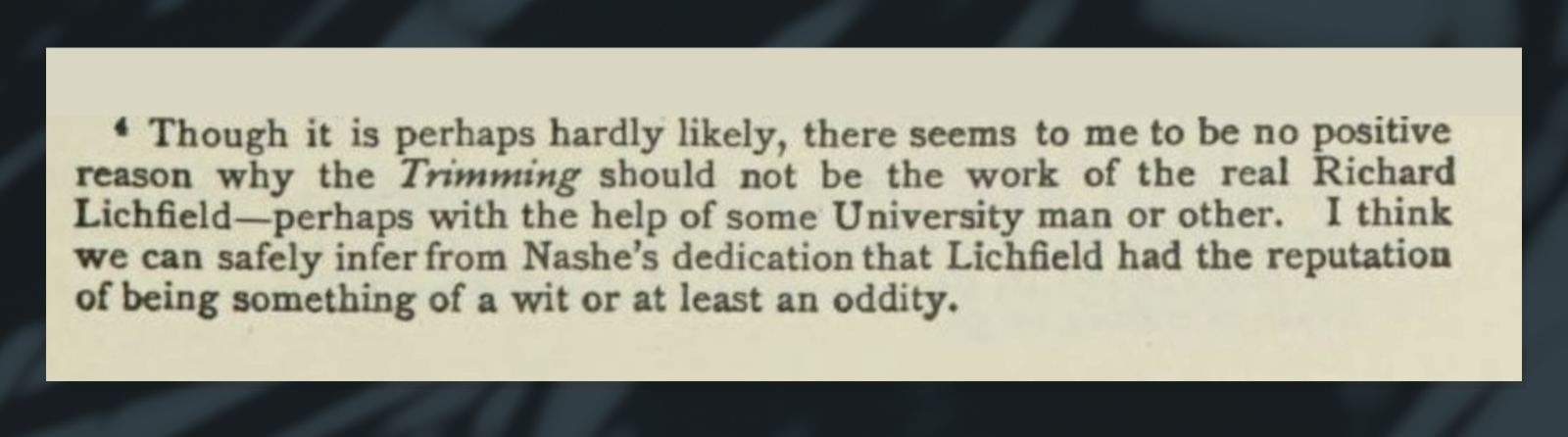
What did our editor write in this idiotic footnote, you ask? I’ll tell you, though you probably won’t believe it. R. B. McKerrow wrote that though it was “perhaps hardly likely” that Lichfield was the author, there seemed “no positive reason why” it “should not be the work of the real Richard Lichfield.”
Presto, we have a new author, just like that.
Though it is perhaps hardly likely, there seems to me to be no positive reason why Trimmingshould not be the work of the real Richard Lichfield—perhaps with the help of some University man or other. I think we can safely infer from Nashe’s dedication that Lichfield had the reputation of being somewhat of a wit, or at least an oddity.2
Of course it’s “hardly likely” a barber no one’s ever heard of wrote Thomas Nashe back. In print. I have to say, reading these foundational editors of the Elizabethan age is one of the most mind-blowing experiences of my life. (And I once dropped acid at the Texas State Fair.)
Two steps to easy editing of the historical record.
A quick and dirty explanation of how we got here: Shakespeare scholarship grew up from book collectors who became editors. The way to become an editor was to be able to get to an old pamphlet or some other piece of Elizabethan literature, and so a small segment of the population who had access to the libraries of nobility and other book collectors could find some piece of writing connected to the world of Shakespeare and reprint it—with an introduction and notes that were as often as not a mere mix of opinions and guesses—filled up the world with introductions that instantly became a brick in the building block of Elizabethan history. By the time R. B. McKerrow rolled into town the editors tended to be more professionalized, at least in their way. They were more likely to have a literature degree and perhaps even to have held a teaching position, but the die had been cast and set long ago, and by the late 19th Century, Shakespeare scholarship was solidly centered on a bunch of guys using Shakespeare plays as a sort of message board to argue about parentheses and guess at who was really meant in that reference. (Oh, the wild world of Shakespeare Variorums.)
But setting aside the big, big reason for the warp, there was another, more grounded and simple reason that this area of academia may have become such a strange cognitive distortion tank, and that is that the guys writing it into the record were often dealing with printed materials that were extremely obscure and exceptionally rare, and so if you wanted to say that a parody ‘repentance pamphlet’ on an executed criminal that began with the anonymous author falling asleep and dreaming that ghosts gave him papers to publish actually contained evidence explaining serious financial irregularities, you could call that anonymous author ‘Ratsy’s biographer’ and feel pretty confident that no one would ever know what a fraud you were perpetrating. These editors ‘knew’ no one could ever check them, a fact that might even make an honest man cut an occasional corner, but if a person was dishonest, the sky was the limit for their lies.
In the case of McKerrow’s edition of the Works of Thomas Nashe there are five volumes, one containing just the notes, one containing the biography and appendices, and the other three with the actual text of the books and pamphlets. So obviously it is possible that a reader could have all five and check what Dr. McKerrow wrote about Nashe, but when it came to anything else, like the words of Gabriel Harvey that play such an outsized part in the story—or his supposed writing, as Trimming had been assumed to be before McKerrow came along—almost everyone was forced to rely soley on this unserious hack.
Dragging myself back to point again, if a reader had waited to read the little footnote changing both bibliography and history until after they’d read the rest of the page—the footnote about how it was hardly likely that some barber named Lichfield wrote and published a response to one of the most famous Elizabethans living—or happened to let their mind wander for an instant, they might have gotten whiplash when someone by the name of Lichfield was suddenly treated as the author: “Lichfield tells us in his address to the reader. . .”
As unbelievable as it is, in less than a page a so-called scholar went from “perhaps hardly likely” and “no positive reason” why some barber might not have printed a reply to the rockstar of stage and print, maybe with “the help of some University man or other”, to handing off authorship of a work of importance in Elizabethan history to a barber no one had ever heard of, and dropping a new character into an important history whom he would make dissapear just as fast as he had made him appear.
Okay, but what does “Dick Lichfield” tell us in his address to the reader? (If you were around for some of the Beatles’ shocks, you may think you’re prepared for brazen prevarication, but I’m here to tell you you’re wrong. You ain’t seen cold, callous brazenness till you’ve spent some time with Dr. R. B. McKerrow.)
In Dr. Ronald McKerrow’s telling of what this Lichfield fellow says in his address to the reader, he serves up a line of his own compiled with two pieces of a quote from the second sentence in the Trimming’s opening. I probably ought to say up front that with a few odd exceptions, McKerrow’s quotations, in and of themselves, are usually pristine. He’s not slicing and dicing quotes in any way that breaks the technical rules, he’s just lying his ass off in general.
His inauguratory use of “Lichfield” in the position of author is the one that gives us our first two quotes taken from the pamphlet. (All quotations from Dr. McKerrow in this piece will come from Volume 5 of his Works of Thomas Nashe.) He writes:
The Trimming was entered to Cuthbert Burby on October 11, 1597, so that almost a full year elapsed between Have with You and this reply. Lichfield tells us in his address to the readerthat he had been long in doubt whether, ‘considering the man and the matter,’ it would be wise to reply at all, but had at last decided to do so, and had polished off the business in ‘the stolne houres of three weekes’ (107-8).
It’s a boring sentence from McK, but it’s far less boring in the Trimming, because the sentence this history–defacer took his quotelets from begins in a way that makes it well-nigh impossible to have come from a random barber in Cambridge:
“His Epistle I expected any time these three yeares, but this mine aunswer sine fuco loquar[‘to speak without disguise’], (though it be not worthy to bee called the worke of one well spent houre) I haue wrought foorth out of the stolne houres of three weekes: for although occasion hath been offered euer since the Epistle hath been extant, to answere it: yet held in suspence considering the man and matter, whether I should take it vpon mee or no: at last concluding him easily answerable, I haue vndergone it. . .”3
His Epistle I expected any time these three years? That was thirty or so words from “the stolne houres of three weeks” that our editor used to try to make it seem like words written by a barber in Cambridge pondering a pamphlet that had been randomly addressed to him. A barber who just happened to hate Thomas Nashe for some reason. (Despite Nashe being the person sticking up for the Cambridge butler that the Harveys dragged into print and publicly called stupid for the horrible sin of sharing a name with their enemy.)
A certain kind of Doctor grown pitifully bald
‘I am sure thou wonderest not a little what I mean, to come upon thee so strangely with such a huge dicker of Dicks in a heap altogether . . . There is a certain kind of Doctor of late very pitifully grown bald, and thereupon is to be shaven immediately. . .’
Thomas Nashe, Have With You to Saffron VValden (iii. 6. 5-8)
Most importantly, it was no barber, but Richard Harvey that Thomas Nashe was addressing in his Have With You to Saffron VValden dedication, and that would be evident to anyone with even a poor understanding of the basic facts, because Nashe goes so overboard in playing with the references to the brothers in his outrageously long opening. Even if you didn’t know anything about Master Doctor Gabriel Harvey or his brother, it’s a vicar with astrological leanings and his scholarly brother that are constantly punned on and poked at, and almost everything that might seem to point to a barber is just a play on the clergy, on top of which unless this barber was very notorious for loving the hated hexameter verse—as Gabriel Harvey most infamously was—it was no barber that Nashe was talking to.
While giving the younger brother a thin cover, Nashe was also plain as to why he was mocking him with the moniker of a barber: Richard Harvey had published a book on fighting baldness by cutting the hair more—privately printed—that Thomas Nashe had come across. And Richard Harvey probably had been waiting for Nashe’s pamphlet, although I’m not so sure a reply from him was expected on Nashe’s side.
. . .a divine vicarly brother of his called Astrological Richard, some few years since (for the benefit of his country) most studiously compiled a profound abridgment upon beards . . . & no less fruitlessly determined betwixt the swallow’s-tail cut & the round beard like a rubbing-brush. It was my chance (O thrice blessed chance), to the great comfort of my muse, to peruse it, although it came but privately in print . . .
If you’re one of the four people in the world that has read Have With You to Saffron VValden and you felt like Nashe wasn’t having fun—I mean, he ends it with Ovid’s “You are the author of this crime for me”, except in Latin, of course: “Tu mihi criminis Author”—now I at least know that there was a reason he seemed like he was forcing himself through it. And the oddities start early, opening with Nashe telling Gabriel’s little brother that there was no remedy but he must join Nashe to give brother Gabriel the “terrible cut”. The cut that would, in some ways, protect the elder Harvey, but in other ways would shame him for all eternity. And like the rest of the dedication, it is loaded down with clerical and hangman puns. (Italics in original, but still modernized.)
. . .without any more delay, off or on, trimmed he must be with a trice, and there is no remedy but thou must needs come and join with me to give him the terrible cut. Wherefore (good Dick) on with thy apron, & arm thyself to set him down at the first word. Stand to him, I say, and take him a button lower; fear not to show him a knack of thy occupation, and once in thy life let it be said that a Doctor wears thy cloth, or that thou hast caused him to do penance, and wear haircloth for his sins.
It’s no surprise that Dr. Alexander Grosart, the first (and last, as far as I know) editor of the Works of Gabriel Harvey, dealing with the original pamphlets and having far less perspective than would come with time, believed the Trimming to be by elder brother Gabriel. Despite McKerrow’s nonsense, Richard writes a whole lot like Gabriel, only that with Richard all of Gabriel’s irritating affectations and the sense of traversing a road made up only of potholes is increased, and his shockingly child-like immaturity always shows through. He also favors margin notes. But it strains credulity to believe it was not obvious to a second editor, with the benefit of a previous Works of both Nashe and Harvey, that Nashe was writing to Richard Harvey and that it was Richard Harvey answering the call. There’s simply no mistaking the fact of either. On every single page of Nashe’s long dedication in Have With You it’s clear that he is talking to Richard about his brother Gabriel. Nashe calls him his brother again and again, and doesn’t hide the name.
But R. B. McKerrow did hide the first nine words of the sentence that he used to insert a falsehood into the historical record, words that would have unmasked his absurd lie and proved it to be an impossibility. Because no one can, with a straight face, come up with any reason why some barber in Cambridge or anywhere else would have been waiting three years for Thomas Nashe to dedicate a pamphlet to him:
“His Epistle I expected any time these three yeares. . .”
It is not his most consequential lie by any stretch of the imagination, but it might be his stupidist.
❦
Have with You to Saffron-Walden had been humorously dedicated in a long railing epistle to Richard Lichfield, barber to Trinity College, and the reply which appeared in 1597, The Trimming of Thomas Nashe, purports to be the work of this person, or, as he is styled on the title-page, ‘the high-tituled patron Don Richardo de Medico campo.’
R. B. McKerrow, Works of Thomas Nashe, v. 107. 3-8.
I make jewelry and try to read everything on the US Civil War and Reconstruction that comes out, (thereby knowing many smart people.) I know a bit of law, care about Beatles historiography and love the Nagras. Jane Austen whispered her Emma secrets to me across many miles and 200 years. ✨ My father was Bill Sargent, the Pay Per View Beatles guy. #DYRBRY
View all posts by Serene Sargent